

 EN
 English
 中文简体
Textile-Grade High-Purity Recycled Polyester Chips for Knitted Fabric
Content
- 1 What Are Recycled Polyester Chips?
- 2 Why High Purity Matters in Textile Production
- 3 From Discarded Bottles to Textile Feedstock
- 4 Advantages Over Conventional Virgin Polyester Chips
- 5 Connection with Recycled Yarn Manufacturing
- 6 Product Portfolio Supporting the Chip Application
- 7 Functional and Differentiated Yarn Capabilities
- 8 Manufacturing Strengths and Process Control
- 9 Suitability for Knitted Fabric
- 10 Environmental and Commercial Value
- 11 Advantages for International Buyers
- 12 How to Select the Correct Material
- 13 Recommended Quality Evaluation
- 14 Storage, Handling, and Production Preparation
- 15 Applications in Finished Products
- 16 Why Work with an Experienced Textile Supplier?
- 17 Purchasing Considerations for Wholesale Orders
- 18 Q&A
- 18.1 What are textile-grade recycled polyester chips?
- 18.2 What is the main advantage of high-purity recycled chips?
- 18.3 Can recycled polyester chips be used on mainstream knitting equipment?
- 18.4 What types of yarn can be produced from recycled polyester chips?
- 18.5 What does a specification such as 75/72 mean?
- 18.6 Are recycled chips suitable for apparel?
- 18.7 Can recycled polyester be used for bags and luggage?
- 18.8 What is the difference between semi-dull and full-dull yarn?
- 18.9 What is cationic-dyeable yarn used for?
- 18.10 Why is drying necessary before spinning recycled polyester chips?
- 18.11 Can the supplier accept customized differentiated yarn orders?
- 18.12 What information should buyers request before ordering?
- 18.13 Are recycled polyester products automatically certified?
- 18.14 How can recycled polyester support a lower-impact textile strategy?
- 18.15 What makes this supplier suitable for international textile buyers?
- 19 Conclusion
- 20 References
- 21 Product: Textile-Grade High-Purity Recycled Polyester Chips for Knitted Fabric
Recycled polyester chips have become an important raw material for textile manufacturers seeking to combine reliable production performance with more responsible material sourcing. Textile-grade high-purity recycled polyester chips are designed to convert post-consumer PET containers, including discarded water bottles and beverage bottles, into a stable feedstock for recycled polyester yarn and knitted fabric. Through controlled recycling and purification, this material gives manufacturers an alternative to virgin polyester chips while supporting the circular use of plastic resources.
The product described in this article is developed for textile applications in which melting stability, consistent viscosity, clean processing, and dependable yarn formation are essential. It is suitable for manufacturers producing recycled DTY, FDY, POY, and other polyester-based yarn products, as well as knitted fabrics used in apparel, bags, luggage, accessories, and technical textile applications. Its purpose is not simply to replace virgin material, but to provide a practical recycled solution that can be integrated into established polyester spinning and knitting operations.
With experience in differentiated yarn development, recycled yarn, functional yarn, and knitting fabric, Suzhou Junhui Textile Co., Ltd. and Suzhou Xiaoran New Materials Co., Ltd. serve customers requiring both raw materials and downstream textile solutions. Their product range includes recycled yarn, normal polyester yarn, cationic-dyeable yarn, high-elastic yarn, PBT/PET yarn, functional yarn, cotton-like yarn, hollow warm yarn, and other differentiated products. This wider technical background helps connect recycled polyester chips with real production requirements rather than treating them as an isolated raw material.
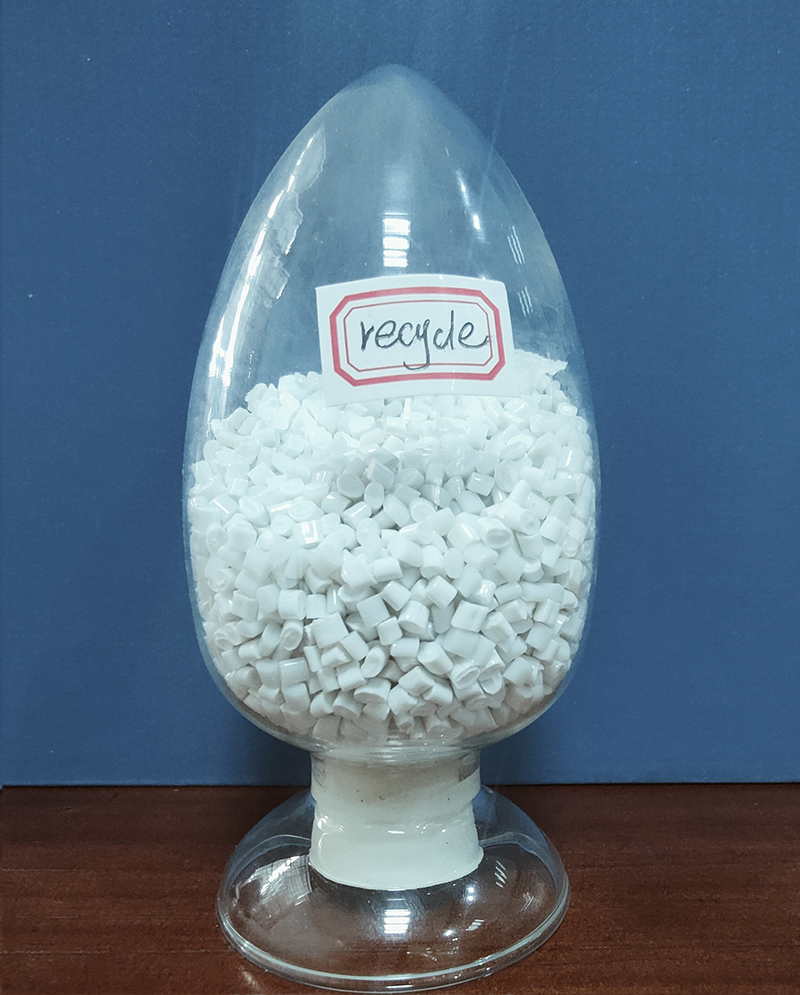
Textile-Grade High-Purity Recycled Polyester Chips for Knitted Fabric
What Are Recycled Polyester Chips?
Recycled polyester chips are small solid polymer pellets produced by processing recovered polyester materials into a form suitable for melt spinning. The primary source is commonly discarded PET packaging, especially transparent water bottles and beverage containers. After collection, sorting, cleaning, size reduction, and controlled reprocessing, the recovered polyester is converted into chips that can be melted and spun into textile filaments.
Polyethylene terephthalate, generally known as PET, is widely used in bottles because it offers strength, clarity, chemical resistance, and light weight. These same polymer characteristics also make PET useful in textile production. When PET containers are properly recycled and purified, the resulting material can be used as a feedstock for polyester fiber and yarn.
The chip form is important because it allows textile producers to handle the recycled polymer in a familiar way. Chips can be dried, melted, filtered, extruded, and spun through equipment used in polyester yarn production. This compatibility reduces the need for completely new machinery and enables manufacturers to incorporate recycled content into existing operating systems.
High purity is especially important in textile-grade applications. Foreign materials, moisture, residual labels, adhesives, color contaminants, and other impurities can affect melting behavior, pressure stability, spinning continuity, yarn evenness, and final fabric appearance. A high-purity recycled chip is therefore expected to provide more consistent processing than poorly sorted or inadequately purified recycled plastic.
Why High Purity Matters in Textile Production
Textile spinning is a continuous process. Polymer is melted, filtered, metered, extruded, cooled, and drawn into filaments at controlled speeds. Any significant variation in the raw material can influence the entire production line. Inconsistent melting viscosity may cause fluctuations in extrusion pressure, uneven filament formation, increased yarn breaks, or differences in yarn denier.
Low impurity content supports a cleaner melt. A cleaner melt helps protect spinneret openings and reduces the risk of deposits that can interfere with filament formation. It also contributes to more stable operation over longer production runs. For producers of knitted fabric, stable filament quality is important because variations may become visible as streaks, uneven dye uptake, barre effects, or differences in fabric handle.
Moisture control is another important consideration. Polyester is sensitive to hydrolytic degradation when excessive moisture is present during melting. Proper drying before spinning helps reduce molecular-chain damage and supports more stable polymer performance. For this reason, recycled polyester chips should be stored and prepared under conditions that protect them from moisture absorption before use.
High-purity chips do not eliminate the need for proper processing. Drying temperature, residence time, melt temperature, filtration, spinning speed, draw ratio, winding tension, and other operating variables must still be controlled. However, a consistent raw material gives the manufacturer a stronger foundation for maintaining these parameters and achieving repeatable results.
Compared with low-grade recycled feedstock, high-purity textile chips can offer better production predictability. This advantage is particularly valuable for export-oriented textile factories and knitting mills that need to meet customer expectations across repeated orders. Stable raw material quality can help reduce process adjustments, minimize avoidable waste, and support more consistent product specifications.
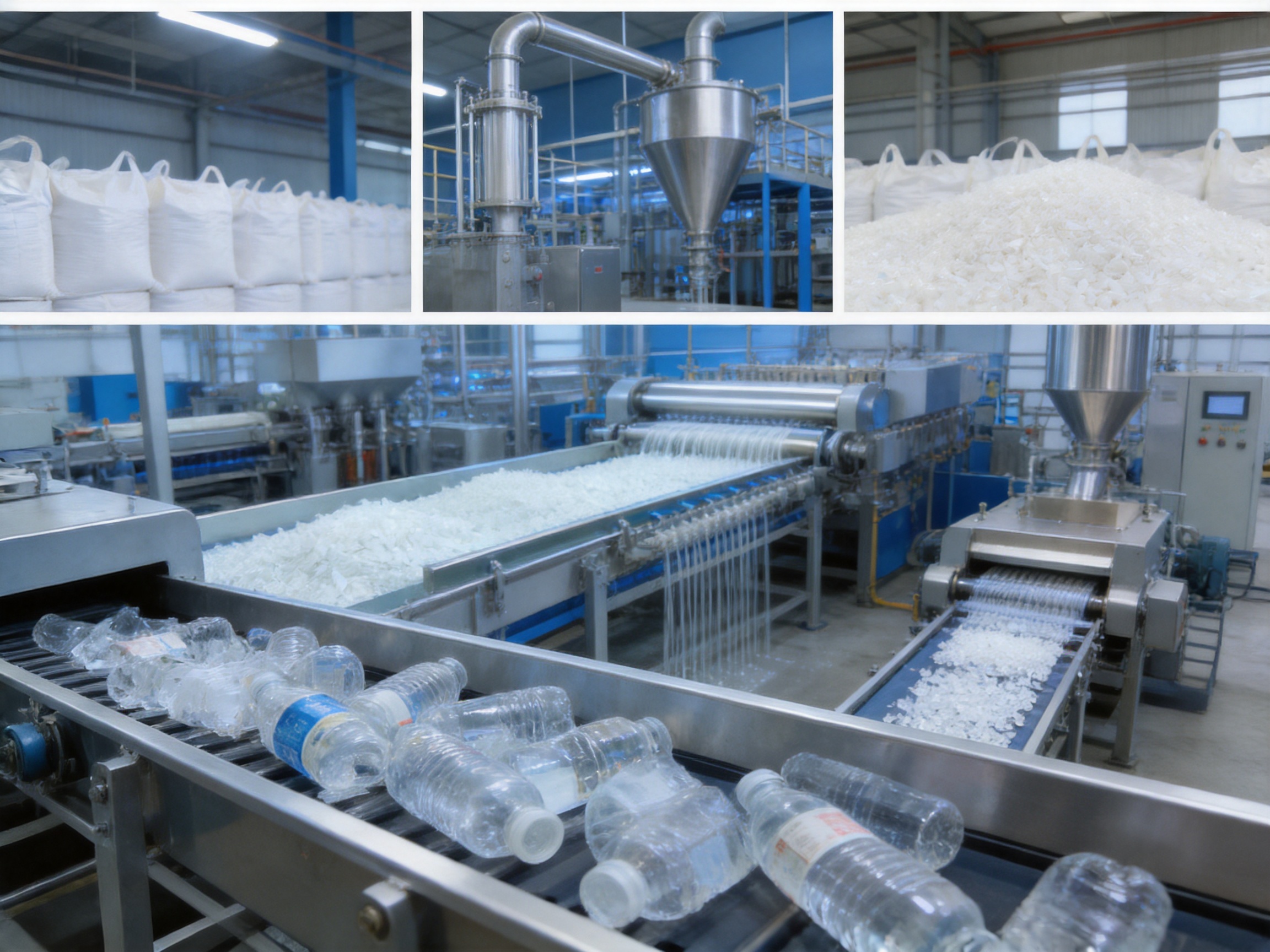
From Discarded Bottles to Textile Feedstock
The recycling process begins with the collection of post-consumer PET containers. These materials are sorted to separate PET from other plastics and non-plastic materials. The sorting stage may include manual inspection, mechanical separation, color classification, and removal of unsuitable items. Effective sorting is essential because the quality of the final chips depends heavily on the quality of the incoming material.
After sorting, the containers are cleaned to remove dirt, beverage residues, labels, adhesives, and other surface contamination. The cleaned bottles are then reduced in size, usually into flakes, so they can be processed more efficiently. Washing and separation steps help improve the purity of the flake material before it enters the next stage.
The PET flakes are dried and processed through controlled thermal and mechanical systems. Depending on the production route, the recovered polymer may be reprocessed through extrusion, filtration, pelletizing, and additional purification stages. The objective is to produce chips with suitable appearance, cleanliness, melting behavior, and viscosity for textile spinning.
During extrusion, the recycled PET is melted and homogenized. Melt filtration helps remove remaining solid contaminants that could damage spinning equipment or interfere with filament formation. The polymer is then shaped into strands, cooled, and cut into uniform pellets. Consistent pellet size supports more reliable feeding and melting in downstream operations.
Quality control can be applied at multiple points throughout this process. Incoming materials may be checked for polymer type, color, contamination, and moisture. Intermediate flakes may be inspected after washing. Finished chips may be evaluated for appearance, viscosity, moisture, impurity level, and other parameters relevant to textile production.
The manufacturing strength of a recycled polyester chip supplier is therefore not limited to pelletizing. It depends on control over the complete chain, from material sourcing and sorting to cleaning, melt filtration, drying, extrusion, and final packaging. A supplier with textile experience can also evaluate the chip from the perspective of yarn spinning and fabric performance.
Advantages Over Conventional Virgin Polyester Chips
Virgin polyester chips are produced from newly manufactured petrochemical raw materials. They remain widely used and can offer highly consistent properties, but they also depend on new fossil-based resources. Recycled polyester chips provide a way to reuse existing PET material and reduce the need for an equivalent amount of virgin polymer feedstock.
The principal environmental advantage is resource circulation. Instead of allowing used PET bottles to become waste, recycling gives the material a second industrial life. The recovered polymer can be returned to the supply chain and converted into yarn, fabric, bags, garments, and other products. This approach supports waste reduction and aligns with the growing preference for materials with a clearer recycling story.
Recycled polyester also responds to changing customer expectations. European and American markets have shown strong interest in recycled and lower-impact textile materials. Brands, retailers, and consumers increasingly ask where fibers come from, how materials are processed, and whether products support more responsible resource use. Textile-grade recycled chips help manufacturers answer these requirements with a material that is directly connected to post-consumer PET recovery.
Another advantage is production compatibility. Because the recycled material is supplied as polyester chips, it can be introduced into polyester melt-spinning systems without changing the basic concept of the production process. Manufacturers can use familiar methods to produce recycled filament yarn and can develop products for knitting, weaving, warp knitting, and other textile applications.
High-purity recycled chips can also help narrow the practical performance gap between recycled and virgin polyester feedstocks. Consistent viscosity and low impurity content support stable spinning, while suitable filtration and process control help maintain filament quality. The precise result depends on the chip specification, equipment, blend ratio, and operating conditions, but a well-produced recycled chip provides a stronger basis for commercial textile production.
For buyers, the advantage is not only environmental positioning. It also includes the possibility of developing a dependable supply program for recycled yarn and fabric. When the raw material is supported by a supplier with experience in yarn manufacturing, technical discussions can address both chip properties and downstream applications.
Connection with Recycled Yarn Manufacturing
Recycled polyester chips are a core raw material for manufacturing recycled polyester yarn. Once the chips are dried and melted, the polymer is extruded through spinnerets to form continuous filaments. These filaments can be drawn, textured, interlaced, wound, and prepared for use in knitting or weaving.
Different yarn structures require different processing conditions. Draw textured yarn, or DTY, is produced by drawing and texturing partially oriented or spun filament yarn to create bulk, stretch, softness, and a more natural appearance. Fully drawn yarn, or FDY, is drawn and stabilized during spinning to produce a more directly usable filament yarn. Partially oriented yarn, or POY, is commonly used as an intermediate feedstock for further texturing.
The material list associated with the product includes recycled semi-dull DTY, recycled semi-dull FDY, recycled full-dull DTY, recycled semi-dull and cationic-dyeable DTY, recycled dope-dyed or deep-black DTY, recycled cationic-dyeable DTY, and other differentiated recycled yarns. These options demonstrate the supplier’s ability to connect recycled polymer materials with various yarn appearances, dyeing behaviors, and functional requirements.
Denier and filament combinations are important in yarn selection. Examples in the product range include 15/6, 20/12 to 24, 30/12 to 36, 50/24 to 72, 75/36 to 144, 100/36 to 144, 150/48 to 288, and 300/96 to 576. The first number generally represents denier, while the second number indicates filament count. A higher filament count at a similar denier can contribute to a finer filament character and a softer hand, while other combinations may be selected for coverage, strength, or production efficiency.
Actual yarn performance depends on more than the chip alone. Polymer quality, spinning conditions, texturing settings, lubricant application, winding control, and inspection all have an influence. The advantage of working with a supplier that understands these relationships is that material selection can be discussed according to the final fabric rather than only by a basic chip description.
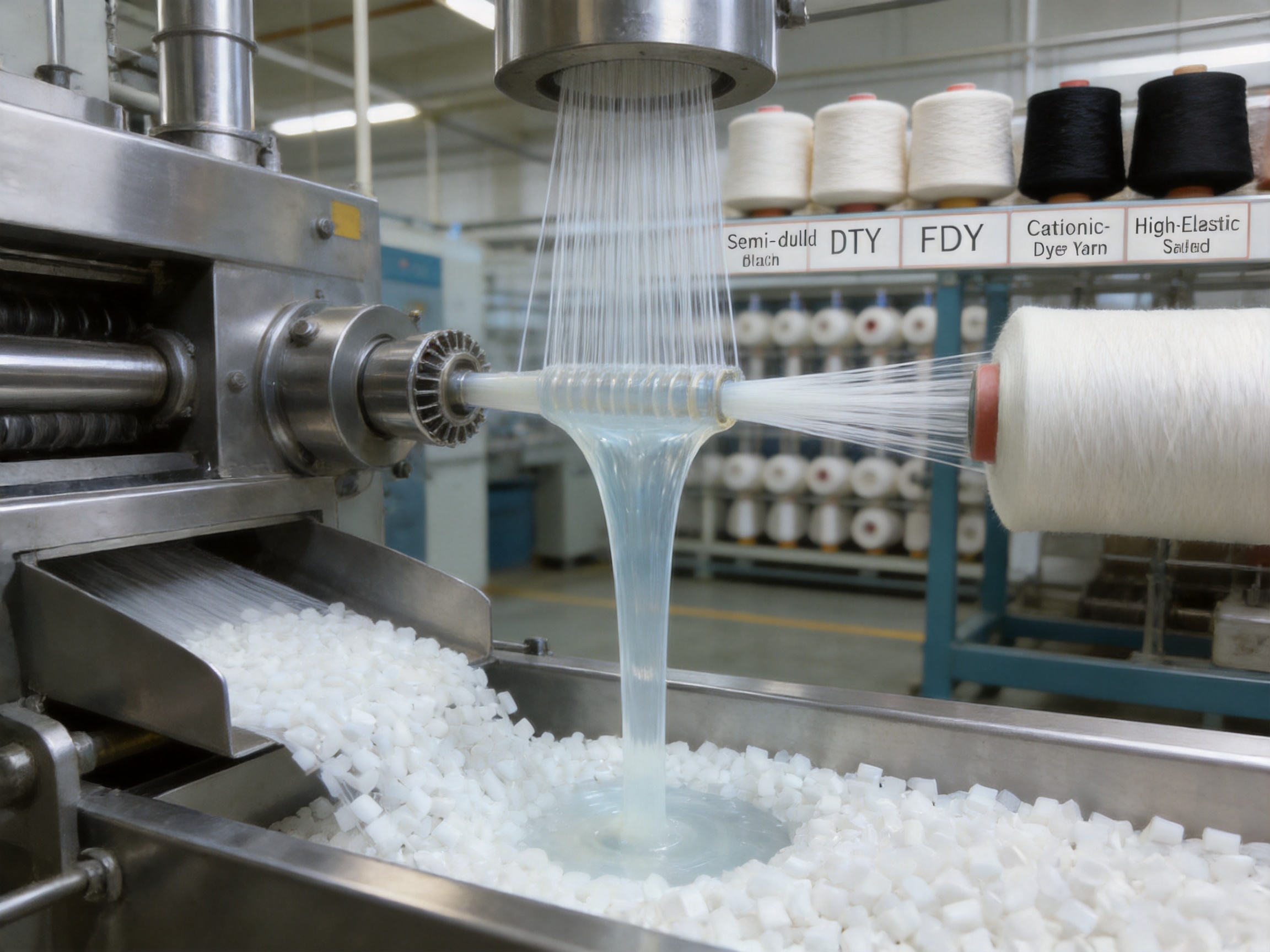
Product Portfolio Supporting the Chip Application
The recycled yarn series includes a broad selection of specifications for different textile purposes. Recycled semi-dull DTY is available in multiple denier and filament combinations for knitted fabrics that require a balanced appearance and comfortable handle. Recycled semi-dull FDY provides a smooth filament option for applications where dimensional stability and a cleaner surface are important.
Recycled full-dull DTY is suitable for fabrics requiring a softer, less lustrous visual effect. Full-dull yarn can be useful in apparel and lifestyle textiles where a subdued appearance is preferred over a bright filament surface. The choice between semi-dull and full-dull yarn allows fabric developers to adjust the visual character of the finished product.
Recycled SD plus CD DTY combines semi-dull and cationic-dyeable characteristics. Cationic-dyeable polyester can be used to create contrast effects, mixed-color appearances, or special dyeing results when combined with conventional polyester or other compatible components. This type of differentiated yarn gives knitting mills more options for developing fabrics with visual depth and a distinctive surface.
Recycled DDB DTY and recycled deep-colored or black DTY can help reduce the need for additional coloration in selected applications. Dope-dyed or deep-colored yarn is colored during polymer processing rather than relying entirely on after-spinning dyeing. Depending on the product and application, this may support color consistency and help reduce some dyeing-stage requirements.
Recycled cationic-dyeable DTY is available in various specifications, including yarns with different filament counts and deniers. It can be selected for fashion fabrics, sportswear, casual apparel, decorative textiles, and other products where color contrast or special dyeing effects are required.
The broader normal series includes semi-dull DTY, full-dull DTY, and semi-dull DDB yarns. Specifications range from fine yarns such as 25/72 and 30/12 to 36 through heavier options such as 200/96 to 384 and 300/96 to 576. This range helps customers compare recycled and conventional options within a familiar product structure.
The CD series includes cationic-dyeable DTY, semi-dull and cationic-dyeable DTY, and white or black yarn options. The listed specifications include 25/24, 30/24 to 36, 50/36 to 72, 75/36 to 144, 100/36 to 144, 150/48 to 288, and 300/96. These yarns can support knitted fabrics requiring special coloration, mixed effects, and differentiated surface appearance.
Functional and Differentiated Yarn Capabilities
A major strength of the supplier is its focus on differentiated yarn rather than only standard polyester products. The high-elastic series includes high-elastic yarn in specifications such as 30/12, 50/36 to 72, 60/72, 75/36 to 72, and 150/48 to 144. High-elastic options may be considered for fabrics that need improved stretch, recovery, comfort, or body-hugging performance.
The product list also includes PBT/PET yarn and PBT/PET DDB yarn. PBT/PET constructions combine polyester components with different elastic and recovery characteristics. Available examples include 50/48 and 75/36 for PBT/PET, as well as related specifications for PBT/PET DDB. These products can support stretch-oriented knitting applications where a balance of resilience and processability is required.
Functional yarn options include flame-retardant, antibacterial, and moisture-wicking yarn. Flame-retardant yarn is developed for applications where reduced flammability is an important requirement, subject to the applicable testing and end-use standard. Antibacterial yarn can be selected for products where odor control or hygiene-related performance is desired. Moisture-wicking yarn is intended to help move moisture away from the skin or across the fabric surface, supporting comfort in sportswear and active applications.
The functional series includes specifications such as 50/48 to 72 and 75/36 to 48 to 72 for flame-retardant yarn, 150/48 to 72 to 96 to 144 for selected functional applications, and 30/24 through 150/48 to 72 for moisture-wicking yarn. Customers should confirm the required performance level, testing method, and intended use before final selection.
Cotton-like yarn is another differentiated product. Available options include 32S, 40S, and 80S. These yarns are developed to provide a cotton-like visual or tactile effect while retaining the processing advantages associated with polyester. They can be used in apparel, knitted garments, casual fabrics, and products that seek a natural-looking surface.
Hollow warm yarn is available in specifications including 75/72 and 150/144. Hollow structures can help create a lighter yarn with an insulating air space, making the material suitable for selected warm-feel fabrics and seasonal apparel. Acy yarn options, such as 40 plus 75/36 to 72, 30 plus 100/96, and 40 plus 150/48 to 144, provide additional possibilities for combined or composite yarn effects.
Manufacturing Strengths and Process Control
The manufacturing strength behind textile-grade recycled polyester chips comes from integrating material preparation, polymer processing, yarn development, and textile application knowledge. A supplier focused only on recycled plastic may understand recovery and pelletizing but have limited experience with filament spinning. A textile company with recycling and yarn capabilities can evaluate the raw material according to the demands of actual knitting and fabric production.
Material preparation is the first control point. Recovered PET must be sorted carefully to limit incompatible polymers and foreign matter. Cleaning must remove residues that could affect the polymer melt. Drying must be sufficient to reduce moisture-related degradation. These steps create the foundation for chip consistency.
Extrusion and melt filtration are central to chip production. The recycled polymer must be melted uniformly and passed through filtration systems designed to remove remaining solid contaminants. Stable extrusion supports consistent strand formation and pellet cutting. Uniform chips are easier to feed into dryers and extruders during downstream yarn production.
Process monitoring is valuable throughout production. Operators may observe melt pressure, temperature, filtration behavior, pellet appearance, moisture, and other indicators. Finished chip samples can be assessed before shipment so that material variation is identified as early as possible. For international customers, consistent packaging and batch identification are also important for traceability and warehouse management.
Downstream yarn production adds another layer of technical control. Polyester chips must be dried under suitable conditions before melting. The spinning system must maintain stable temperature and pressure. Filtration at the spinning stage helps protect the spinneret. Drawing and texturing must then be adjusted to the selected denier and filament combination.
The supplier’s professional research and development team works with internationally recognized enterprises on research, development, and application related to environmental protection, functional yarn, and fabric. This experience supports product customization and helps customers select suitable solutions for specific fabrics. The company also states that it can accept orders for various differentiated yarns, which is useful for buyers seeking more than standard stock items.
Manufacturing capability is strengthened by the combination of product breadth and application knowledge. A customer may begin with recycled polyester chips, move to recycled DTY or FDY, and then develop a knitted fabric specification. Having related capabilities in one supply network can simplify communication and reduce the risk of mismatched material recommendations.
Suitability for Knitted Fabric
Knitted fabrics are formed by interlooping yarn, which means yarn flexibility, uniformity, friction, crimp, and surface behavior all influence production. Recycled polyester chips intended for knitted fabric must therefore support yarns that can run smoothly through knitting equipment and form stable loops.
Recycled DTY is especially relevant to knitted fabric because texturing creates bulk and elasticity that can improve coverage and handle. DTY can be used in circular knitting, warp knitting, and other fabric structures, depending on the yarn specification and machine requirements. Semi-dull, full-dull, cationic-dyeable, dope-dyed, and functional versions allow fabric developers to adjust appearance and performance.
FDY provides a smoother filament structure and can be used where a cleaner surface, lower hairiness, or more stable filament character is preferred. FDY can also serve as a component in composite yarn constructions or be combined with other yarns to create special fabric effects.
Knitted fabrics made with recycled polyester can be used in clothing, sportswear, casualwear, outdoor products, bags, luggage, school bags, handbags, shopping bags, gift bags, and fashion accessories. The final application depends on the yarn specification, knitting structure, finishing treatment, dyeing process, and performance requirements.
For mountaineering bags and luggage, manufacturers may prioritize strength, abrasion resistance, stable color, and dimensional control. For apparel, softness, moisture management, stretch, visual appearance, and comfort may be more important. For shopping bags and fashion accessories, surface texture, color range, durability, and sustainability communication can influence material selection.
Before mass production, knitting mills should conduct trials using their own machine settings. Recycled yarn can behave differently depending on equipment condition, needle selection, knitting speed, yarn tension, and finishing process. Trial knitting helps confirm loop formation, fabric weight, width, stretch, dye uptake, and appearance.
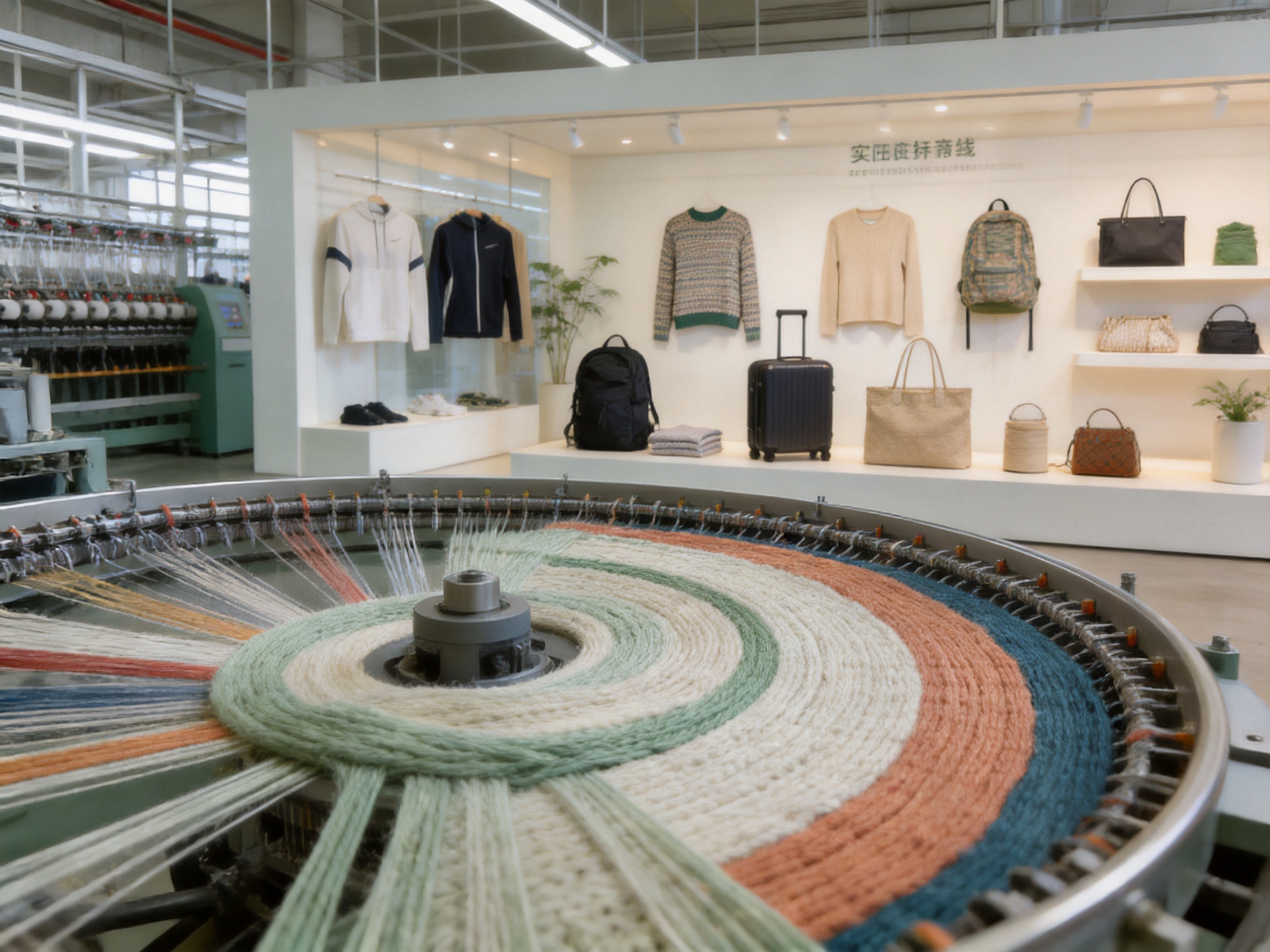
Environmental and Commercial Value
The environmental value of recycled polyester begins with the recovery of materials that might otherwise be discarded. Turning used PET bottles into textile feedstock supports a more circular material flow. It does not mean that plastic waste disappears, but it gives a useful material another product life and can reduce dependence on newly produced polyester resources.
Recycled polyester also gives textile manufacturers a commercially recognizable sustainability story. Products made with recycled PET yarn can be marketed for their use of recovered post-consumer material, provided the claims are supported by appropriate documentation and the exact recycled content is accurately stated. Clear communication is essential because customers increasingly distinguish between recycled content, recyclable design, and other environmental claims.
For brands and importers, recycled yarn can help meet product development goals related to lower-impact sourcing. It may be incorporated into knitted garments, bags, luggage, accessories, home textiles, and promotional products. The same raw material platform can support multiple product categories, allowing manufacturers to develop a coordinated recycled product range.
The commercial benefit also comes from product flexibility. The available recycled yarn specifications cover fine, medium, and heavy deniers, different filament counts, different luster levels, cationic-dyeable options, black or colored options, and functional constructions. Buyers are not limited to a single generic recycled yarn. They can select materials according to fabric appearance, hand, weight, stretch, color, and application.
A broad range can help reduce development time. Instead of searching for separate suppliers for standard recycled yarn, cationic yarn, high-elastic yarn, moisture-wicking yarn, and cotton-like yarn, a customer can discuss several options with a supplier experienced in differentiated polyester products. This can be particularly useful for textile groups developing seasonal collections or multiple product lines.
Advantages for International Buyers
More than 90 percent of the company’s products are exported, according to the supplied company information. The company has established customer relationships in 36 countries, demonstrating experience in serving international textile markets. Export experience can support communication regarding product specifications, packaging, lead times, shipping arrangements, and application requirements.
International buyers often need a supplier that can respond quickly to technical questions. The company states that its experts are prepared to provide assistance globally within 12 hours. Timely communication is useful when buyers are comparing denier and filament combinations, resolving knitting issues, planning sample trials, or adjusting a product specification for a new customer.
Location in Shengze Town, Suzhou, places the business in a major textile manufacturing region. Access to textile mills, yarn processors, knitting factories, dyeing facilities, and logistics services creates an industrial environment suited to product development and supply coordination. The regional textile ecosystem can help connect raw material decisions with downstream manufacturing realities.
Buyers can request technical information before placing an order. Useful details may include chip appearance, intrinsic viscosity or another agreed viscosity measure, moisture level, impurity control, melting behavior, packaging format, minimum order quantity, available specifications, color options, sample policy, and recommended processing conditions. The exact data should be confirmed directly for each batch and application.
Responsible procurement also requires buyers to verify recycled-content claims, documentation, and applicable standards where needed. Requirements may differ by country, customer, product category, and certification program. A supplier discussion should cover the documentation needed for the intended market rather than assuming that every recycled material carries the same qualification.
How to Select the Correct Material
The first step is to define the final product. A light knitted garment, a stretch sportswear fabric, a luggage lining, a heavy bag, and a fashion accessory may all require different yarn characteristics. Selecting a recycled chip or yarn without understanding the final fabric can lead to unnecessary trials or performance compromises.
The second step is to determine the desired yarn structure. DTY is often selected for bulk, softness, and texturing effects. FDY may be more suitable for a smooth and stable filament surface. POY can be used as an intermediate material for texturing. Composite options such as SD plus CD, PBT/PET, and Acy yarn can create special performance or appearance effects.
Denier and filament count should be selected together. Fine deniers with higher filament counts can contribute to softness and a refined surface. Heavier deniers can provide stronger coverage and a more substantial hand. The appropriate balance depends on fabric weight, knitting gauge, stretch requirements, abrasion expectations, and finishing conditions.
Luster is also a key choice. Semi-dull yarn offers moderate reflection, while full-dull yarn produces a quieter and more subdued appearance. Dope-dyed or deep-colored yarn may be considered when strong color consistency or a reduced dyeing requirement is desired. Cationic-dyeable yarn can create contrast and two-tone effects when used correctly with compatible fibers.
Functional requirements should be clearly stated. If the fabric must manage moisture, provide stretch, offer warmth, reduce flammability, or support antibacterial performance, the buyer should identify the required test method and performance target. General descriptions are not enough for technical approval; measurable requirements ensure that the material is selected for its real end use.
Finally, a sample trial should be completed. The trial should examine spinning or knitting behavior, yarn tension, fabric appearance, dyeing response, dimensional stability, softness, stretch recovery, and any relevant physical tests. Trial results help confirm that the material performs correctly on the buyer’s specific equipment.
Recommended Quality Evaluation
A professional evaluation of recycled polyester chips should include both laboratory checks and processing trials. Laboratory checks may cover appearance, color, moisture, viscosity, chip size, contamination, and other agreed parameters. The exact test methods should be established between the supplier and buyer before regular supply begins.
Appearance inspection can identify discoloration, excessive dust, black spots, foreign particles, or irregular pellets. While appearance alone cannot determine complete quality, it is a useful first indication of sorting and pelletizing control.
Moisture testing is essential before spinning. Chips that have absorbed moisture during storage may require appropriate drying before entering the extruder. Packaging should remain sealed until the material is ready for preparation, particularly in humid environments.
Viscosity consistency is important because it influences melt flow and filament formation. Buyers should compare the supplier’s reported measurement with their own internal testing method where possible. A common testing procedure makes batch-to-batch comparison more meaningful.
Processing trials should monitor spinning pressure, melt stability, filament breaks, yarn evenness, winding performance, and downstream texturing behavior. For knitted fabric, additional checks should include knitting efficiency, fabric weight, width, loop regularity, dyeing uniformity, and finished fabric handle.
Quality evaluation should be based on the complete product route. A chip can meet a laboratory specification yet require different drying or spinning settings from another material. Cooperation between supplier and buyer helps identify suitable operating conditions and prevents incorrect conclusions based on a single test.
Storage, Handling, and Production Preparation
Recycled polyester chips should be stored in clean, dry conditions and protected from direct contamination. Bags should remain properly sealed during transportation and warehousing. Excessive exposure to moisture, dust, oil, or incompatible materials can affect processing quality.
Before use, chips should be checked for packaging damage, unusual odor, visible contamination, and any signs of moisture exposure. If the material has been stored for an extended period or transported through humid conditions, the buyer should follow an appropriate drying procedure based on the supplier’s technical recommendation and the requirements of the spinning equipment.
Drying should be controlled rather than excessive. Insufficient drying may leave moisture in the polymer, while overly aggressive conditions may create unnecessary energy consumption or affect material handling. The correct procedure depends on chip characteristics, dryer design, residence time, air quality, and production rate.
Material from different batches should be managed carefully. Blending may be appropriate when batch specifications are compatible, but uncontrolled mixing can make it difficult to trace process changes. Maintaining batch records supports more accurate troubleshooting and helps buyers identify the source of any variation.
Good housekeeping is also important. Clean hoppers, conveying systems, dryers, extruders, filters, and spinning components reduce the risk of introducing contaminants into a clean recycled polymer stream. Equipment inspection and preventive maintenance further support stable yarn production.
Applications in Finished Products
Recycled polyester yarn derived from high-purity chips can be used in many products. In clothing, it can support T-shirts, sportswear, casualwear, jackets, dresses, knitted tops, and functional garments. Yarn selection can be adjusted to provide softness, stretch, moisture management, warmth, or a specific visual effect.
In outdoor products, recycled polyester can be used for mountaineering bags, backpacks, luggage, school bags, briefcases, and travel accessories. These applications may require durable fabric, stable color, tear resistance, abrasion resistance, and a controlled surface appearance. The final performance depends on fabric construction and finishing as well as yarn selection.
In fashion accessories, recycled yarn can be incorporated into handbags, shopping bags, gift bags, fashion bags, storage boxes, and decorative products. Cationic-dyeable, black, colored, cotton-like, and textured options can help designers develop differentiated surfaces and color effects.
Knitted fabric made from recycled polyester can also be used in home textiles, linings, lightweight covers, promotional products, and other textile goods. The broad product portfolio makes it possible to develop materials ranging from fine and smooth fabrics to bulky, elastic, warm, or functional constructions.
Because recycled polyester is suitable for both standard and specialized product development, it can serve as a platform material for a complete collection. A buyer may use one recycled source for basic apparel, another yarn construction for sportswear, and a deeper-colored or textured option for bags and accessories.
Why Work with an Experienced Textile Supplier?
Purchasing recycled polyester chips from a supplier with downstream textile knowledge offers several practical advantages. The supplier can discuss how raw material quality influences yarn spinning, how yarn construction influences knitting, and how fabric finishing affects final performance. This application-based approach is more useful than discussing recycled content alone.
Suzhou Junhui Textile Co., Ltd. and Suzhou Xiaoran New Materials Co., Ltd. were founded in June 2015 and have focused on differential yarn development and sales. Their experience covers recycled yarn, polyester dope-dyed yarn, specialized yarn, microfine yarn, flame-retardant yarn, cationic-dyeing yarn, and knitting fabric. This product diversity indicates a capability to support customers across several stages of textile development.
The company’s research and development activities include cooperation with internationally recognized enterprises on environmental protection, functional yarn, and fabric development. Such cooperation can help translate market requirements into practical material solutions. It also supports the development of products that combine recycled content with appearance or performance characteristics needed by modern textile manufacturers.
The company’s export-oriented business model provides experience with overseas customers and varied market expectations. Its stated customer base spans 36 countries, while more than 90 percent of its products are exported. For international buyers, this background may simplify discussions involving product specifications, samples, packaging, and order planning.
The company emphasizes customer success as a central business principle and offers assistance with product selection and problem solving. For a buyer developing a recycled knitted fabric, this support can be valuable during the early stages, when the correct denier, filament count, luster, functional treatment, and knitting structure are still being evaluated.
Purchasing Considerations for Wholesale Orders
Wholesale buyers should begin by preparing a clear technical brief. The brief should identify the desired product, recycled content objective, yarn type, denier, filament count, luster, color, functional requirements, fabric construction, estimated annual demand, and target market. The more precise the brief, the more efficiently the supplier can recommend a suitable option.
Sample development should take place before a large production order. Samples allow the buyer to evaluate the material under real machine conditions and compare it with existing virgin or recycled alternatives. They also provide an opportunity to review the finished fabric with the brand or end customer.
Order planning should consider production capacity, lead time, packaging, shipping schedules, and seasonal demand. Recycled textile products may require careful coordination because fabric programs are often linked to retail calendars. Early communication helps reduce the risk of last-minute changes.
Buyers should also discuss color management when ordering black, white, dope-dyed, or cationic-dyeable products. Color expectations should be defined with approved standards or samples. Batch variation, dyeing conditions, and fabric finishing can influence the final result, so the complete color process must be considered.
For functional yarn, buyers should request appropriate test information and clarify whether the required performance is permanent, durable through repeated washing, or intended for a specific processing route. Performance claims should always be connected to a recognized test method and the intended end use.
Finally, buyers should establish an agreed quality specification. This specification can include appearance, packaging, moisture, viscosity, denier, filament count, yarn evenness, breaking strength, elongation, color, and defect limits. Clear specifications protect both parties and create a consistent basis for future orders.
Q&A
What are textile-grade recycled polyester chips?
They are recycled PET polymer pellets processed for use in textile applications. They are commonly made from recovered PET bottles and are designed to be melted and spun into polyester yarn for knitted fabric, woven fabric, bags, clothing, luggage, and accessories.
What is the main advantage of high-purity recycled chips?
High purity helps provide cleaner and more stable polymer processing. Low impurity content can support consistent melting, stable spinning pressure, fewer contamination-related interruptions, and more uniform yarn and fabric quality.
Can recycled polyester chips be used on mainstream knitting equipment?
Yes. The chips are intended to produce recycled polyester yarn compatible with common polyester spinning and knitting production systems. Actual performance depends on equipment, drying, spinning conditions, yarn construction, and knitting settings, so production trials are recommended.
What types of yarn can be produced from recycled polyester chips?
They can be used as a raw material for recycled DTY, FDY, POY-related products, semi-dull yarn, full-dull yarn, cationic-dyeable yarn, dope-dyed yarn, black yarn, high-elastic yarn, and selected functional or composite yarns.
What does a specification such as 75/72 mean?
In common filament-yarn notation, the first number generally refers to denier and the second number refers to filament count. The exact interpretation and tolerance should be confirmed in the supplier’s technical specification for the particular product.
Are recycled chips suitable for apparel?
Yes. Recycled polyester yarn made from suitable chips can be used in knitted apparel, sportswear, casualwear, jackets, and other garments. The selected yarn should match the required softness, stretch, moisture management, appearance, dyeing behavior, and durability.
Can recycled polyester be used for bags and luggage?
Yes. Recycled polyester yarn and fabric are suitable for many bags, backpacks, school bags, handbags, shopping bags, travel products, and luggage components. The material selection should reflect the required abrasion resistance, tear strength, fabric weight, coating, and construction.
What is the difference between semi-dull and full-dull yarn?
Semi-dull yarn has a moderate level of luster, while full-dull yarn has a softer and less reflective appearance. The choice depends on the desired visual effect, fabric design, and customer preference.
What is cationic-dyeable yarn used for?
Cationic-dyeable yarn can be used to create special color effects, contrast, mixed-color appearances, and two-tone designs when combined with compatible polyester components. It is often selected for fashion fabrics and differentiated knitted products.
Why is drying necessary before spinning recycled polyester chips?
Polyester can be affected by moisture during melting. Proper drying helps reduce hydrolytic degradation and supports stable melt viscosity, extrusion, filament formation, and yarn quality.
Can the supplier accept customized differentiated yarn orders?
The supplied product information states that orders for various differentiated yarns can be accepted. Buyers should provide the desired denier, filament count, luster, color, functional performance, structure, quantity, and end-use requirements for evaluation.
What information should buyers request before ordering?
Buyers should request the current technical specification, available denier and filament combinations, recycled-content information, quality parameters, packaging details, sample availability, minimum order quantity, lead time, test data, and documentation needed for the destination market.
Are recycled polyester products automatically certified?
No. Recycled content and certification are separate matters. Buyers should confirm what documentation is available and whether it meets the requirements of their brand, customer, country, or certification program.
How can recycled polyester support a lower-impact textile strategy?
It can help reuse post-consumer PET material, reduce reliance on virgin polyester feedstock, and support a circular approach to resource management. Environmental benefits should be communicated accurately and supported by appropriate product information.
What makes this supplier suitable for international textile buyers?
The company has export experience, a broad product portfolio, research and development capabilities, and experience with customers in multiple countries. Its combination of recycled materials, differentiated yarn, functional products, and knitting fabric knowledge can support integrated textile development.
Conclusion
Textile-grade high-purity recycled polyester chips provide a practical route from discarded PET containers to new yarn and knitted fabric. Their value comes from the combination of recycled resource use and textile processing performance. When the chips are properly sorted, cleaned, dried, filtered, extruded, and pelletized, they can provide a dependable feedstock for recycled polyester yarn production.
The product is especially relevant for manufacturers seeking material solutions for apparel, sportswear, bags, luggage, accessories, and other knitted textile goods. Its compatibility with established polyester processing equipment allows factories to introduce recycled content without abandoning familiar manufacturing methods.
High purity, low impurity content, stable melting viscosity, and consistent spinning behavior are important advantages over lower-grade recycled alternatives. At the same time, the supplier’s broad range of recycled and differentiated yarns gives customers more opportunities to adjust denier, filament count, luster, color, stretch, warmth, moisture management, and other properties.
Suzhou Junhui Textile Co., Ltd. and Suzhou Xiaoran New Materials Co., Ltd. combine recycling-related material development with yarn manufacturing, research and development, export experience, and fabric application knowledge. This integrated strength can help buyers move from raw material selection to yarn production and final knitted fabric development with fewer communication barriers.
For the best result, buyers should define the final application, conduct sample trials, confirm technical specifications, evaluate the material on their own equipment, and establish clear quality and documentation requirements. With proper selection and process control, high-purity recycled polyester chips can support reliable textile manufacturing while contributing to a more resource-efficient and sustainable polyester supply chain.
References
1. Company product information for recycled polyester chips, recycled yarn, functional yarn, differentiated yarn, and knitting fabric applications.
2. Company information regarding Suzhou Junhui Textile Co., Ltd. and Suzhou Xiaoran New Materials Co., Ltd., including export markets, research and development activities, and product categories.
3. General technical principles of polyethylene terephthalate recycling, melt extrusion, pelletizing, drying, and polyester filament spinning.
4. General textile engineering principles for denier, filament count, draw textured yarn, fully drawn yarn, semi-dull yarn, full-dull yarn, and cationic-dyeable polyester.
5. General sustainability principles concerning post-consumer PET recovery, recycled polyester production, resource circulation, and responsible environmental communication.
Product: Textile-Grade High-Purity Recycled Polyester Chips for Knitted Fabric

Popular products
-
Premium Cationic Interlock Stretch Comfort Fabric
-
Moisture-Wicking Nylon Woven Fabric
-
Double-faced jacquard elastic fabric
-
Heather Grey Double-faced cationic jersey fabric
-
Anti-static Cationic Knitted Rib Fabric
-
High-Stretch Cationic Jersey Fabric
-
High Quality Cationic DTY Spandex Two Sides Brush Dralon Knit Fabric for Garment Thermal Underwear
-
Durable Anti-Pilling Knitted Fabric for Home Textiles
-
Wash-Resistant Cationic Elastic Knitted Fabric for Garment Industry
-
Breathable Double-Faced Elastic Composite Fabric
-
-
-
- whatsapp:
- 0086-13962559622
-
- skype:
- skype.aliceshenghong
-
- Wechat:

COPYRIGHT © 2016 Suzhou Junhui Textile Co., Ltd.
