

 EN
 English
 中文简体
Drop-Dyed Yarn: Advanced Color Performance, Flexible Specifications, and Sustainable Textile Solutions
Content
- 1 Understanding the Structure of Drop-Dyed Yarn
- 2 Product Scope and Available Yarn Categories
- 3 Advantages of Drop-Dyed Yarn Over Conventional Coloration
- 4 Advanced Manufacturing Processes
- 5 Why the Supplier’s Product Portfolio Is Competitive
- 6 Applications Across the Textile Industry
- 7 Environmental and Resource-Efficiency Considerations
- 8 How to Select the Correct Drop-Dyed Yarn
- 9 Recommended Quality-Control Workflow
- 10 Customer Service and Technical Collaboration
- 11 Practical Benefits for International Buyers
- 12 Future Development of Drop-Dyed and Differential Yarn
- 13 Q&A About Drop-Dyed Yarn
- 13.1 What is drop-dyed yarn?
- 13.2 How is drop-dyed yarn different from conventionally dyed yarn?
- 13.3 Is drop-dyed yarn suitable for knitted fabrics?
- 13.4 What does SD mean in polyester yarn?
- 13.5 What does FD mean in polyester yarn?
- 13.6 What does DTY mean?
- 13.7 What does FDY mean?
- 13.8 Can drop-dyed yarn be made from recycled polyester?
- 13.9 Can the yarn be customized?
- 13.10 What applications are suitable for high-elastic yarn?
- 13.11 Can cationic-dyeable yarn create special fabric effects?
- 13.12 What should be tested before placing a large order?
- 13.13 How should buyers choose between recycled and conventional polyester yarn?
- 13.14 What information should be included in a yarn inquiry?
- 14 Conclusion
- 15 References
- 16 Product: Drop-dyed Yarn
Drop-dyed yarn is a specialized textile material designed to deliver reliable color performance, consistent appearance, and efficient production for a wide range of knitted and woven fabrics. Unlike conventional yarns that are dyed after fabric formation, drop-dyed yarn is produced by incorporating color during the polymer or spinning stage. This approach can improve color consistency, simplify downstream processing, and support the development of distinctive textile effects.
Modern buyers increasingly require yarn that combines appearance, performance, production efficiency, and environmental responsibility. A single yarn order may need to satisfy requirements for denier, filament count, luster, cross-section, elasticity, moisture management, recycled content, or special functions. The product range presented by Suzhou Junhui Textile Co., Ltd. and Suzhou Xiaoran New Materials Co., Ltd. addresses these needs through a broad portfolio of polyester differential yarns, recycled yarns, functional yarns, and knitting-related materials.
The company’s product list includes recycled semi-dull and full-dull DTY, recycled FDY, recycled dope-dyed yarn, cationic-dyeable yarn, CD yarn, high-elastic yarn, PBT/PET yarn, fire-retardant yarn, antibacterial yarn, moisture-wicking yarn, cotton-like yarn, hollow warm yarn, and other differentiated products. This breadth gives textile manufacturers more options when selecting raw materials for sportswear, casualwear, uniforms, home textiles, upholstery, seamless garments, socks, underwear, and technical fabrics.
Drop-dyed yarn is particularly valuable for customers seeking a stable and scalable coloration solution. It can be produced in black, white, and other customized colors, while its technical structure can be adjusted to suit different fabric constructions. The result is not simply a colored filament, but a material platform that can be adapted to the design, performance, and manufacturing requirements of each application.
Understanding the Structure of Drop-Dyed Yarn
Drop-dyed yarn is commonly understood as yarn colored through the addition of pigment or color masterbatch before or during spinning. In conventional package dyeing, greige yarn is formed first and colored later in a separate wet process. In drop-dyed or dope-dyed production, color is introduced earlier, allowing the colorant to become integrated into the polymer matrix or filament structure.
This production principle offers several practical advantages. Because the color is distributed throughout the filament rather than applied only to its outer surface, the yarn can provide good color stability in many textile applications. The process can also reduce the need for certain post-spinning dyeing operations, helping manufacturers lower water consumption, shorten processing routes, and improve production planning.
The exact appearance of the yarn depends on several technical variables. These include polymer composition, pigment dispersion, spinning temperature, extrusion conditions, draw ratio, texturing parameters, filament count, cross-sectional design, luster, and winding quality. A high-quality drop-dyed yarn therefore requires more than the addition of color. It requires precise control over raw materials, equipment, processing conditions, and final inspection.
For buyers, the most important point is that color performance and yarn performance must be considered together. A yarn may have an attractive color but still fail to meet requirements for tensile strength, elongation, evenness, crimp, shrinkage, or knitting stability. A reliable manufacturer must balance these properties throughout the production process.
Product Scope and Available Yarn Categories
The supplied product list demonstrates a comprehensive approach to differentiated yarn manufacturing. The range covers both standard polyester yarns and specialized products that are designed for specific end uses. This allows customers to source multiple yarn families from one experienced supplier instead of coordinating separate suppliers for recycled, functional, elastic, and color-specific materials.
Recycled Yarn Series
The recycled series includes recycled SD DTY, recycled FDY, recycled FD DTY, recycled SD+CD DTY, recycled DDB DTY, and recycled CD DTY. These products are intended for customers who want to incorporate recycled polyester into textile production while retaining the flexibility associated with conventional polyester yarn.
Available specifications include a broad selection of denier and filament combinations. Examples include 15/6, 20/12-24, 30/12-24-36, 50/36-48-72, 75/36-72-144, 100/36-48-96-144, 150/48-96-144-288, and 300/96-192-288-576 in listed recycled categories. Other recycled formats include 40/24-72, 50/24-36-48-72, 66/24, 75/36-72-144, 100/72, 150/48-144, and several CD and SD+CD combinations.
Recycled yarn can be used in garments, home textiles, sportswear, accessories, and other products where brands or manufacturers seek to reduce dependence on virgin raw materials. The use of recycled content does not remove the need for quality control. On the contrary, recycled polymer requires careful preparation, filtration, drying, and process management to support stable spinning and consistent yarn performance.
Normal Polyester DTY Series
The normal series includes SD DTY, FD DTY, and SD DDB yarn. DTY, or draw textured yarn, is valued for its bulk, stretch response, soft hand feel, and suitability for knitting and weaving. Semi-dull yarn provides a controlled luster, while full-dull yarn offers a more subdued visual effect for fabrics that require a matte or less reflective appearance.
Listed specifications in the normal range include 25/72, 30/12-24-36-72, 50/36-48-72-144, 75/36-48-72-144, 100/36-48-96-144, 120/144, 150/48-96-144-288, 200/96-288-384, and 300/96-192-288-576. The FD DTY category includes options such as 30/36, 50/72, 75/36-72-144, 100/72-144, 120/192, and 150/144-192-288.
This range supports applications requiring different levels of coverage, softness, fabric weight, and surface texture. Fine filament configurations can be used where a softer and more delicate hand is required, while higher denier or higher filament options can support fuller fabric structures and more substantial coverage.
Cationic and Combined-Effect Yarn
The CD series includes CD DTY and SD+CD DTY. Cationic-dyeable polyester is designed to create color contrast or special visual effects when used with conventional polyester in the same textile. Because the two components respond differently during dyeing, manufacturers can create mélange, two-tone, cross-dyed, or other differentiated appearances.
Listed CD DTY specifications include 25/24, 30/24-36, 50/36-72, 75/36-72-144, 100/36-48-72-144, 150/48-144-288, and 300/96. The SD+CD range includes 50/48-72, 75/48-72, 80/72, 100/72-108-144, 125/72-144, 150/72-108-144, and 300/96-144-288.
These yarns are useful for brands and fabric mills that want to achieve visual depth without relying solely on printing or complex post-finishing. Their differentiated dyeing behavior can contribute to attractive fashion effects in knitted tops, dresses, sportswear, scarves, decorative fabrics, and casual garments.
High-Elastic and PBT/PET Series
The high-elastic series includes high-elastic yarn, PBT/PET yarn, and PBT/PET DDB yarn. Listed high-elastic specifications include 30/12, 50/36-72, 60/72, 75/36-72, and 150/48-144. The company also lists SD/FD high-elastic options such as 30/24, 50/36-48-72, 75/36-48-72, 150/72-144, and 300/96-144.
PBT/PET yarn combines polyester-based materials to provide useful elastic recovery and comfort characteristics. It can be considered for garments that require body conformity, movement comfort, or recovery after repeated wear. Potential applications include sportswear, leggings, underwear, socks, swimwear, fitted knitwear, and elasticized fabric constructions.
Elasticity is influenced by yarn structure, texturing, polymer selection, fabric construction, and finishing. Buyers should therefore evaluate the yarn together with their intended knitting or weaving process. A supplier with multiple yarn structures can help customers select an appropriate balance between stretch, recovery, covering power, softness, and process stability.
Functional Yarn Series
The functional series includes fire-retardant yarn, antibacterial yarn, and moisture-wicking yarn. Listed fire-retardant options include SD/FD 75/36-72 and SD/FD 150/36-48-144. Antibacterial yarn is listed in 50/48-72, 75/36-48-72, and 150/48-72-96-144 formats. Moisture-wicking options include 30/24, 50/48-72, 75/48-72, and 150/48-72.
Functional yarns are developed to add a performance feature at the fiber or yarn stage. This can be more efficient than attempting to introduce every performance characteristic through a surface treatment after fabric formation. However, the final performance of any functional fabric also depends on fabric density, finishing, laundering, garment design, and testing conditions.
Moisture-wicking yarn is suitable for sportswear, base layers, outdoor clothing, uniforms, and active lifestyle products. Antibacterial yarn may be considered for products where odor control or hygiene-related performance is important. Fire-retardant yarn may be used in applications where resistance to ignition or flame spread is required, subject to the relevant end-use standards and independent testing requirements.
Cotton-Like, Hollow Warm, and Acy Yarns
The cotton-like series includes 32S, 40S, and 80S options. These yarns are designed to provide a cotton-inspired hand feel while retaining the process and care advantages associated with polyester. Cotton-like polyester can be used in apparel, knitwear, home textiles, and blended fabric constructions where softness and a natural touch are desired.
Hollow warm yarn is listed in 75/72 and 150/144 formats. The hollow structure can help create a lighter yarn with increased bulk and insulation potential. These properties may be useful in sweaters, thermal garments, blankets, scarves, bedding, and other products where warmth and low weight are important.
Acy yarn options include 40+75/36-72, 30+100/96, and 40+150/48-96-144. Composite or combined yarn structures can create a different surface, hand feel, coverage level, or visual effect compared with a single-component yarn. Such products can help designers develop fabrics with more distinctive texture and performance characteristics.
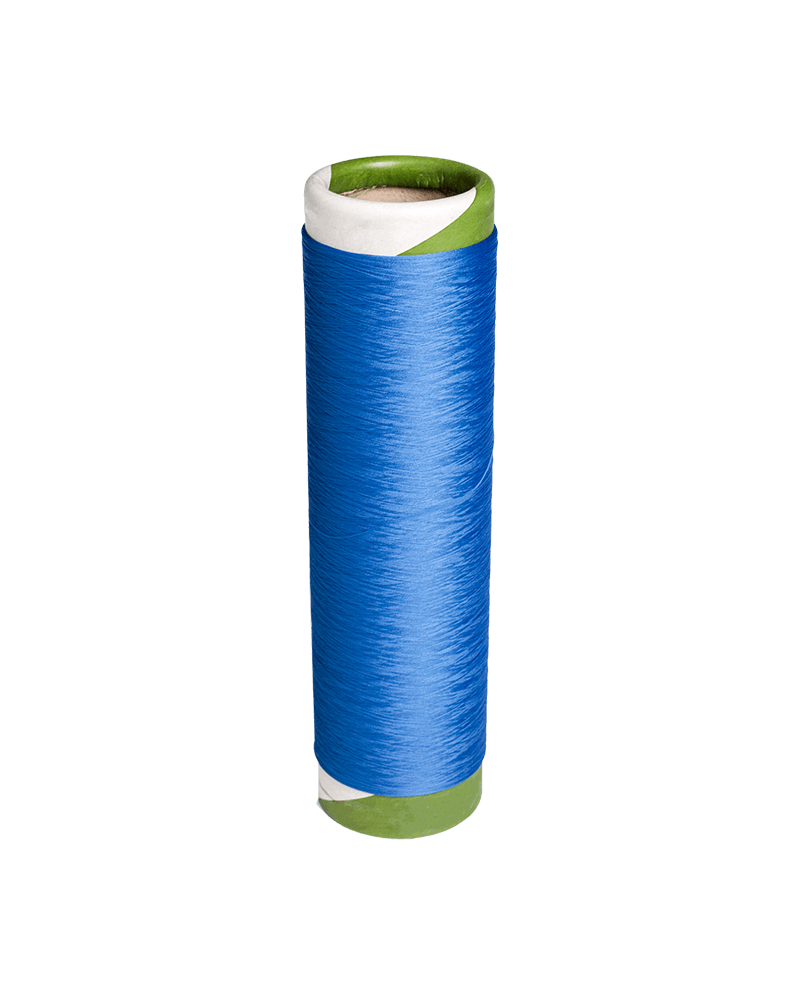
Drop-dyed Yarn
Advantages of Drop-Dyed Yarn Over Conventional Coloration
Consistent Color Distribution
One of the principal benefits of drop-dyed yarn is the potential for consistent color distribution within the filament. When the colorant is properly dispersed before spinning, each filament can receive a more uniform coloration. This helps reduce variation between yarn sections and supports a stable fabric appearance.
Color consistency is particularly important in large production orders. Small differences between lots can become visible when fabric panels are placed side by side or when garments are assembled from different production batches. A controlled dope-dyeing process can help reduce this risk, although lot control, approved standards, laboratory dips, and final inspection remain essential.
Reduced Water and Chemical Requirements
Conventional polyester dyeing usually requires a separate wet process after yarn production. Depending on the product and factory setup, this can involve water, heat, dyes, auxiliaries, rinsing, drying, and wastewater treatment. Drop-dyed yarn introduces color earlier, which may reduce or eliminate some downstream dyeing steps.
This can contribute to lower water use and a shorter processing route. It may also reduce the quantity of wastewater generated by coloration. The environmental advantage depends on the complete manufacturing system, including polymer preparation, pigment selection, energy use, packaging, transportation, and the eventual fabric-finishing process. Nevertheless, early-stage coloration is an important option for textile manufacturers seeking more efficient production.
Improved Colorfastness Potential
Because the colorant is integrated into the polymer structure, drop-dyed yarn may provide strong resistance to certain forms of surface color loss. This is especially useful for dark shades, black yarns, outdoor products, upholstery, and fabrics exposed to repeated washing or friction.
Performance should always be confirmed through testing appropriate to the intended application. Relevant evaluations may include washing fastness, rubbing fastness, perspiration fastness, light fastness, sublimation behavior, and color migration. A qualified supplier can provide technical guidance on the most suitable test program.
Efficient Production and Shorter Processing Routes
Removing or reducing a separate yarn-dyeing stage can simplify supply-chain planning. Fabric mills may be able to move more quickly from yarn purchase to knitting or weaving, particularly when standard shades are available from stock. Fewer wet processes can also lower handling requirements and reduce the time associated with drying and reconditioning.
For manufacturers producing basic black, white, or other frequently used colors, the efficiency gains can be significant. For customized shades, the benefit depends on minimum order quantities, color development time, masterbatch availability, and the supplier’s ability to stabilize the requested shade over repeated orders.
Reliable Performance in High-Use Applications
Drop-dyed yarn can be advantageous for products that experience frequent washing, friction, sunlight, or heavy use. Examples include workwear, uniforms, sportswear, backpacks, automotive textiles, curtains, upholstery, and household fabrics. A durable coloration method can help maintain the visual quality of the product throughout its service life.
In addition to color performance, the yarn must meet the mechanical and processing requirements of the fabric mill. The product range’s combination of DTY, FDY, CD, elastic, recycled, and functional yarns provides opportunities to select a structure suitable for the intended use rather than treating color as the only specification.
Advanced Manufacturing Processes
Raw Material Preparation
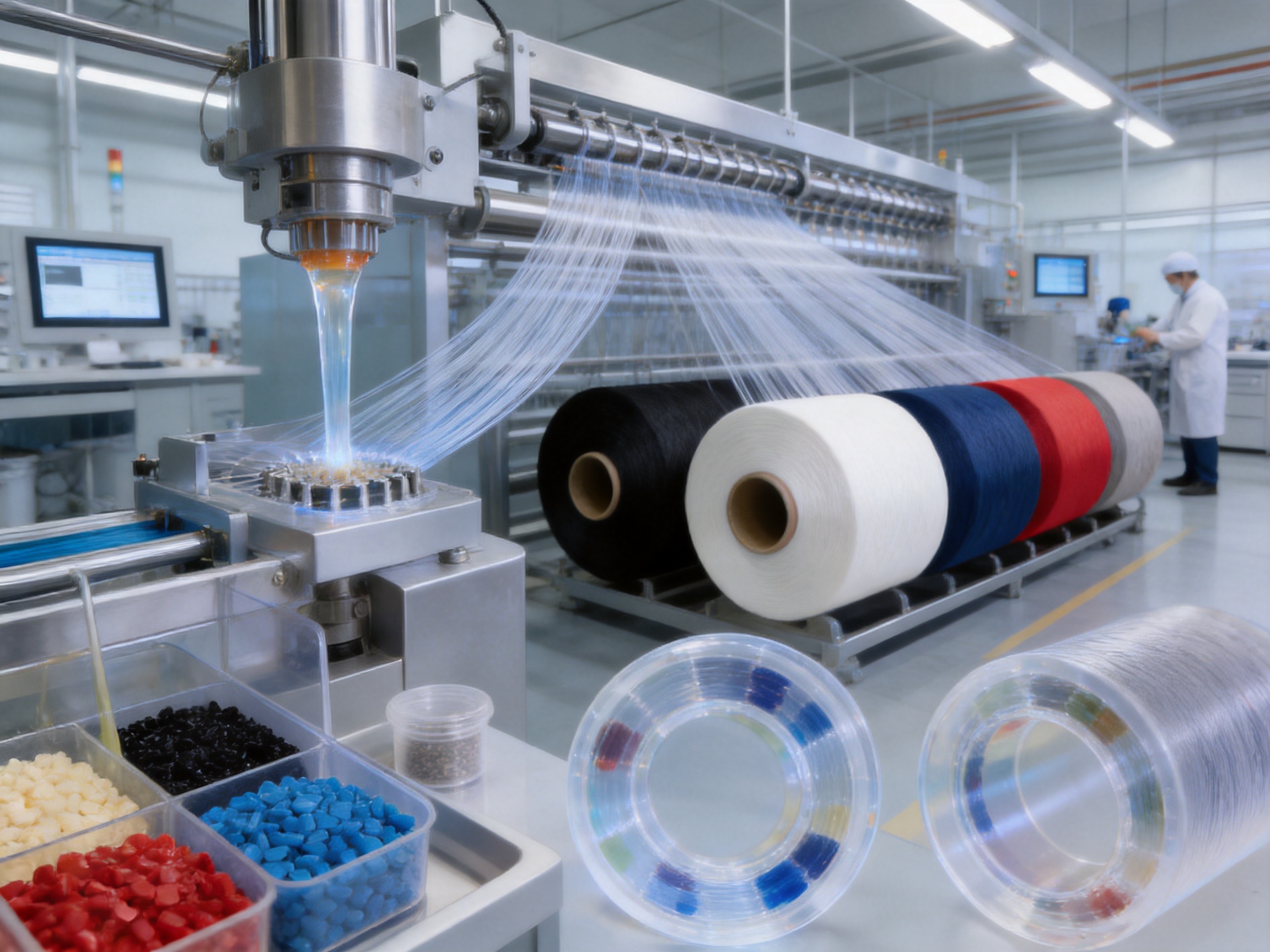
Manufacturing begins with the careful preparation of polyester raw materials, recycled inputs, color masterbatch, and functional additives. Raw material consistency is fundamental because variations in polymer viscosity, moisture, additive concentration, or contaminant level can influence spinning stability and final yarn quality.
Recycled materials require particular attention. Sorting, cleaning, crushing, melting, filtration, and drying must be managed carefully to minimize impurities and support stable polymer flow. Moisture control is also essential because excessive moisture can affect polymer behavior during high-temperature processing. A professional production system therefore treats raw material preparation as a core quality step rather than a preliminary formality.
Masterbatch and Pigment Dispersion
For drop-dyed yarn, color masterbatch or pigment must be dispersed evenly throughout the polymer. Poor dispersion can cause streaks, color points, weak spots, filter blockage, or shade inconsistency. Uniform mixing requires controlled dosing, compatible materials, suitable temperatures, and stable residence time within the extrusion system.
The selection of colorant must also consider the final use of the yarn. Different applications may demand different levels of opacity, brightness, light resistance, heat stability, or chemical resistance. Dark colors and black yarns may require especially careful control to prevent visual variation and maintain an even appearance across filaments.
Melt Extrusion and Spinning
During melt extrusion, the prepared polymer is heated and pushed through a spinneret to form continuous filaments. The spinneret design determines the number and shape of the filaments, while spinning temperature, pressure, cooling conditions, and take-up speed influence filament uniformity.
Stable extrusion helps create yarn with consistent denier, strength, elongation, and surface quality. Online monitoring and disciplined process control are important because even small changes in temperature or pressure can affect the filament profile. The company’s broad specification range indicates the need for flexible production equipment capable of handling different denier and filament-count combinations.
Drawing and Texturing
DTY products are produced through drawing and texturing processes that give the yarn bulk, crimp, stretch response, and a softer hand. Drawing aligns the polymer chains and improves the mechanical properties of the filament. Texturing modifies the filament geometry and creates a more voluminous yarn structure.
The balance between draw ratio, heater temperature, false-twist conditions, spindle speed, overfeed, and winding tension influences the final result. If these parameters are not properly matched, the yarn may show unstable crimp, uneven bulk, excessive hairiness, or knitting problems. Consistent texturing control is therefore vital for customers operating high-speed knitting and weaving machines.
Specialized Differential Processing
Differentiated yarns such as CD, SD+CD, DDB, high-elastic, hollow warm, and composite formats require specialized processing knowledge. These products may combine different polymer behaviors, luster levels, shrinkage characteristics, or filament arrangements. Their value comes from the interaction of these differences during fabric formation and finishing.
For example, SD and CD components may respond differently during dyeing, creating contrast or a two-tone effect. Hollow structures may increase bulk and warmth. PBT/PET constructions may improve elasticity and recovery. The manufacturing challenge is to preserve the intended difference while maintaining sufficient uniformity for stable production.
Winding and Package Formation
After spinning or texturing, yarn is wound into packages for transport and downstream use. Package density, winding angle, tension, edge formation, and package shape can influence unwinding behavior. A yarn with excellent intrinsic properties can still create difficulties if the package is unstable or if tension varies during unwinding.
Good package formation supports smooth knitting, weaving, warping, and covering operations. It can reduce yarn breaks, machine stoppages, fabric defects, and operator intervention. For international customers, package integrity is also important during long-distance transportation and storage.
Inspection and Quality Assurance
Quality assurance should cover both laboratory testing and production-floor inspection. Typical controls may include denier verification, filament count, tensile strength, elongation, crimp properties, shrinkage, evenness, oil content, appearance, package weight, and color comparison.
For colored yarn, shade approval and lot-to-lot comparison are especially important. A controlled color standard should be retained and compared under appropriate lighting conditions. For recycled and functional products, additional documentation and performance testing may be required by the customer or by the final market.
Quality assurance is most effective when it is integrated into every stage of production. Checking only the finished package may identify a problem too late. Monitoring raw materials, extrusion, spinning, texturing, and winding enables earlier correction and improves overall process reliability.
Why the Supplier’s Product Portfolio Is Competitive
Broad Specification Coverage
A major competitive advantage is the breadth of listed specifications. The range covers fine, medium, and heavier denier options, with filament counts extending from lower counts such as 6, 12, or 24 to higher counts such as 144, 288, 384, and 576. This enables customers to select yarn based on fabric weight, coverage, softness, texture, and production equipment.
Many textile buyers do not want to redesign an entire fabric program around a narrow yarn range. They need a supplier capable of supporting multiple product categories and changing seasonal requirements. A broad specification portfolio simplifies sourcing and makes it easier to develop coordinated fabric collections.
Integration of Standard and Functional Products
The supplier combines standard polyester yarn with recycled, cationic, elastic, cotton-like, hollow, antibacterial, moisture-wicking, fire-retardant, and other differentiated products. This integrated approach allows customers to compare alternatives within one technical relationship.
For example, a sportswear manufacturer may require moisture-wicking DTY for one program, recycled DTY for another, and high-elastic PBT/PET yarn for a fitted product. A home textile producer may need hollow warm yarn, cotton-like yarn, and durable colored yarn. A single supplier with multiple capabilities can make product development and communication more efficient.
Support for Customized Differentiation
The product list states that orders for various kinds of differentiated yarn can be accepted. This is important because textile development often begins with a specific fabric effect or performance target rather than a standard catalog number. Customers may require a special combination of denier, filament count, luster, color, elasticity, cross-section, recycled content, or functional treatment.
Customization must be supported by technical evaluation. The supplier needs to assess raw material compatibility, spinning feasibility, minimum order requirements, sample development, testing, and repeat-order control. A manufacturer with a professional research and development team is better positioned to translate a customer’s concept into a production-ready yarn specification.
Experience in Export Markets
The supplied company information states that more than 90 percent of the products are exported and that the business has developed customers in 36 countries. International experience can strengthen a supplier’s understanding of packaging, documentation, lead-time planning, communication, quality expectations, and market-specific product requirements.
Export-oriented production also requires consistency across repeated shipments. Buyers need confidence that approved specifications will remain stable after the initial trial order. Clear production records, retained samples, inspection procedures, and responsive technical communication are important parts of this capability.
Research and Development Orientation
The company information describes a professional research and development team involved in environmental protection, functional yarn, and fabric research. This orientation is valuable because the textile market is moving beyond basic commodity yarns. Brands and fabric mills increasingly seek materials that offer lower environmental impact, improved comfort, special appearance, or performance benefits.
Research and development may involve material selection, spinning trials, texturing adjustments, polymer modification, cross-sectional design, functional additive integration, and fabric testing. The practical value of R&D is measured by whether a new yarn can be produced consistently and used successfully by the customer, not only by whether a laboratory sample can be made.
Applications Across the Textile Industry
Apparel and Fashion Fabrics
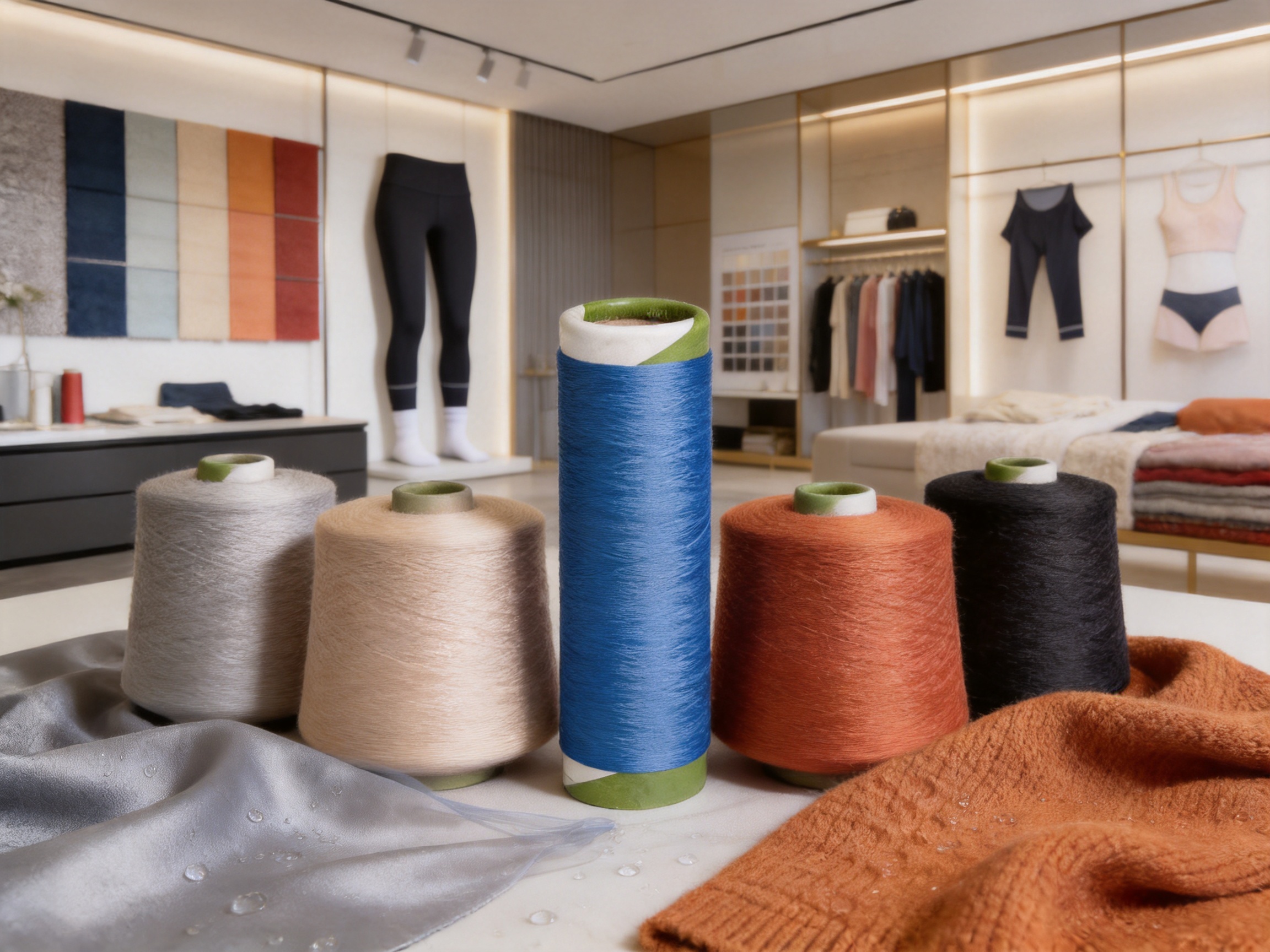
Drop-dyed DTY can be used in knitted tops, dresses, skirts, trousers, jackets, scarves, and other fashion products. Semi-dull and full-dull yarns provide different visual effects, while CD and SD+CD yarns can create depth and contrast. Cotton-like yarn can offer a softer, more natural hand, and high-elastic yarn can support close-fitting garment designs.
Fashion manufacturers often need a combination of appearance and production reliability. A consistent colored yarn can reduce shade variation and help maintain a uniform collection. Special yarn structures can also help designers create texture without relying on complicated fabric treatments.
Sportswear and Outdoor Products
Sportswear requires comfort, moisture management, stretch, durability, and color stability. Moisture-wicking yarn may support faster movement of perspiration away from the skin. High-elastic and PBT/PET yarns can provide stretch and recovery for active garments. Recycled yarn can help brands develop products with a recycled-material story.
Outdoor products may also require resistance to light exposure and repeated care. Colored yarn should be evaluated for the specific lightfastness and washing requirements of the product. Where performance claims are made, testing should be conducted according to the relevant standards and market regulations.
Home Textiles
Home textile applications include bedding, blankets, curtains, cushion covers, upholstery, decorative fabrics, and towels or towel-like constructions. Hollow warm yarn can be considered for lightweight insulation and bulk. Durable colored yarn can support long-term visual performance in curtains and upholstery, where sunlight and friction may be important concerns.
The wide range of denier and filament counts enables manufacturers to choose between fine, soft structures and fuller, heavier constructions. Blending different yarn categories can also create fabrics with a balance of hand feel, strength, appearance, and functional performance.
Uniforms and Workwear
Uniforms and workwear are often expected to withstand repeated washing, abrasion, and prolonged use. Drop-dyed yarn can be considered where stable coloration is important. Fire-retardant yarn may be relevant for selected protective applications, but the finished fabric and garment must meet the required safety standards through verified testing.
Functional yarn options can help manufacturers develop workwear with specific performance targets. However, yarn selection should be made together with fabric construction, finishing, garment design, and care-label requirements.
Knitting and Weaving Production
DTY is widely suited to knitting and can provide bulk, stretch response, and a soft hand. FDY may be used where a smoother, more uniform filament yarn is needed. The choice between SD and FD depends on the desired luster and fabric appearance.
For knitting mills, unwinding stability, yarn evenness, package quality, and low breakage are essential. For weaving mills, strength, elongation, sizing compatibility, and warp stability may be more important. A supplier should help customers match the yarn specification to the machine type and fabric construction.
Environmental and Resource-Efficiency Considerations
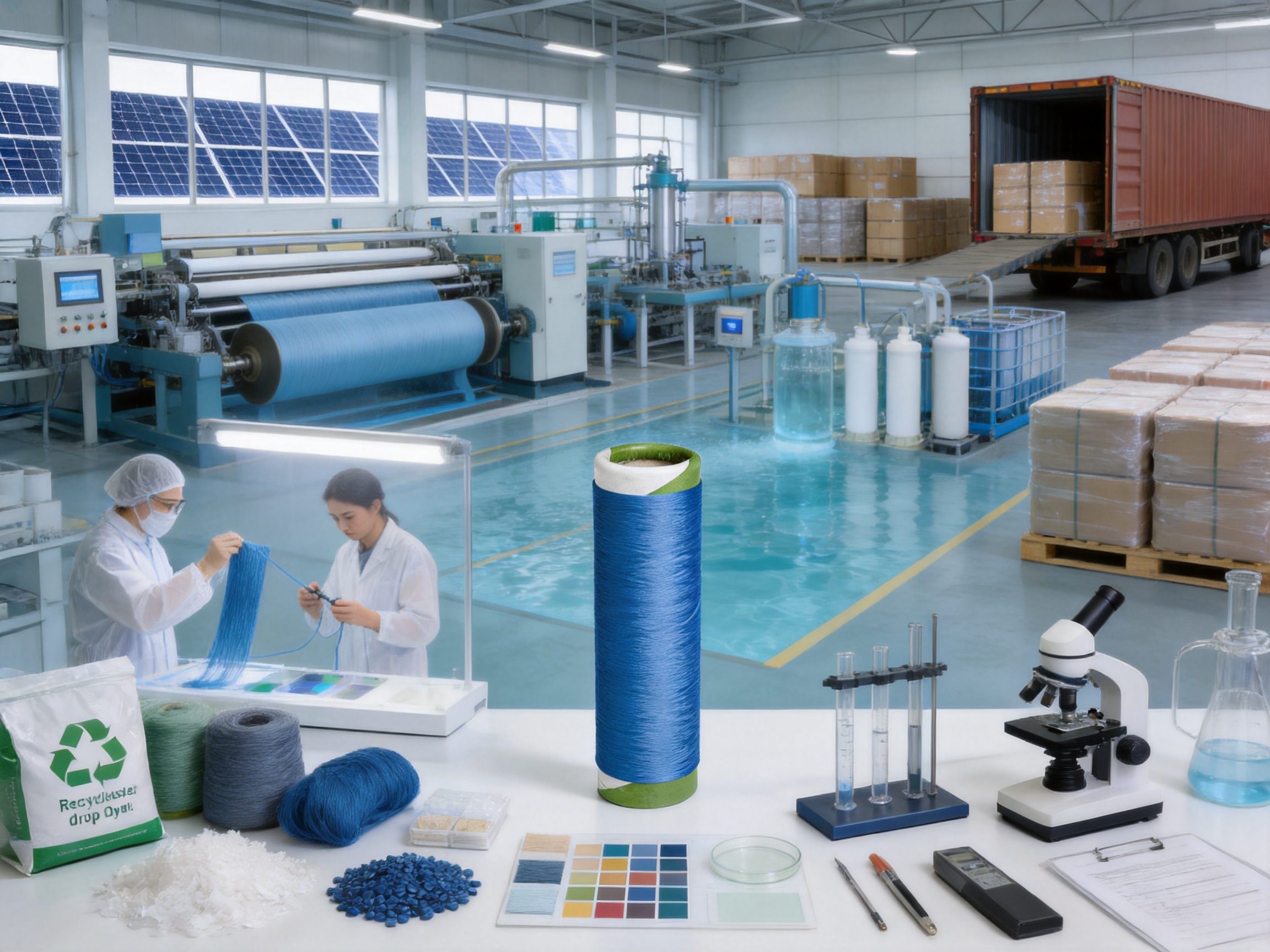
Textile sustainability is a system-wide issue. No single yarn characteristic can determine the environmental profile of a finished product. Nevertheless, recycled polyester and dope-dyed coloration can contribute to a more resource-conscious manufacturing strategy when supported by responsible sourcing, efficient equipment, appropriate testing, and transparent documentation.
Recycled yarn can reduce the need for virgin polyester feedstock by using recovered material in the polymer supply chain. The actual environmental benefit depends on the source of the recycled input, the recycling technology, energy consumption, transportation, and product durability. Durable products that remain in use for longer may provide greater practical value than products that are discarded quickly.
Drop-dyed coloration may reduce water consumption and wastewater associated with conventional yarn dyeing. It can also decrease the number of wet processing steps between polymer and finished fabric. This can support factories seeking to improve resource efficiency and simplify wastewater management.
Customers should request the documentation necessary for their specific sustainability claims. Depending on the market, this may include recycled-content information, supply-chain records, test reports, restricted-substance documentation, and applicable certifications. Claims should be based on verified information and should not exceed the evidence available for the product.
How to Select the Correct Drop-Dyed Yarn
Define the Final Product First
The best yarn selection begins with the finished product. A buyer should identify whether the yarn will be used in sportswear, underwear, sweaters, upholstery, bedding, uniforms, or another application. The target product determines the priorities for softness, luster, stretch, warmth, moisture management, abrasion resistance, colorfastness, and care performance.
Choose Denier and Filament Count
Denier describes the linear mass of the yarn, while filament count indicates how many continuous filaments make up the yarn. In general, a higher denier can provide greater coverage and a fuller fabric, while a higher filament count at a similar denier can influence softness and surface feel. These relationships are not absolute because polymer type, texturing, cross-section, and fabric construction also matter.
The listed options range from fine yarns to heavy yarns and include many filament-count combinations. Customers should test the selected specification on their actual knitting or weaving equipment because machine settings and fabric density can significantly affect the final result.
Select Luster and Surface Effect
Semi-dull yarn provides a controlled, moderate luster, while full-dull yarn creates a more matte appearance. The correct choice depends on the design direction and end use. Cationic and combined SD+CD yarns may be selected when a two-tone or differentiated dyeing effect is desired.
Evaluate Stretch and Recovery
For fitted or active garments, buyers should examine elongation, elastic recovery, heat-setting behavior, and dimensional stability. High-elastic and PBT/PET yarns may offer advantages, but the appropriate structure depends on the required level of stretch and the fabric’s construction.
Confirm Functional Requirements
When selecting antibacterial, fire-retardant, moisture-wicking, hollow warm, or recycled yarn, the buyer should define the performance target in measurable terms. Test methods, conditioning procedures, laundering cycles, and acceptance limits should be agreed upon before production. A functional label alone is not a substitute for testing.
Approve Color and Repeatability
Color approval should be completed using a physical standard or an agreed laboratory reference. Buyers should consider how the yarn will appear after knitting, weaving, heat setting, and finishing. Repeat-order control is also important because the same color must remain consistent across seasons and production batches.
Recommended Quality-Control Workflow
A structured quality-control workflow helps both supplier and buyer reduce risk. The process can begin with a technical specification sheet covering yarn type, denier, filament count, luster, color, twist or texturing requirements, recycled content if applicable, package size, and intended application.
The next stage is sample development. Samples should be knitted or woven under representative conditions rather than evaluated only as loose yarn. This reveals issues related to unwinding, tension, dyeing response, fabric hand, appearance, shrinkage, and finishing.
Laboratory testing can then be conducted according to the end-use requirements. Possible tests include tensile strength, elongation, yarn evenness, crimp, shrinkage, colorfastness, moisture management, antibacterial performance, flame behavior, and recycled-content verification. Not every product requires every test, so the program should be tailored to the application.
Before mass production, the approved sample, color standard, test results, packaging instructions, and inspection criteria should be documented. During production, batch records and retained samples can support traceability. Final inspection should confirm appearance, package condition, weight, labeling, and any customer-specific requirements.
This disciplined approach benefits both parties. The buyer receives greater confidence in production consistency, while the manufacturer receives clear technical information that reduces misunderstandings and avoidable rework.
Product category |
Representative options |
Typical value for customers |
Drop-dyed and colored polyester yarn |
Colored DTY, SD, FD, black and white yarn |
Stable appearance, efficient coloration, reduced downstream dyeing requirements |
Recycled series |
Recycled SD DTY, recycled FDY, recycled CD DTY, recycled SD+CD DTY |
Support for recycled-material product programs and differentiated textile development |
Normal DTY series |
SD DTY, FD DTY, SD DDB |
Flexible choices for knitting, weaving, softness, bulk, and luster |
CD series |
CD DTY, SD+CD DTY |
Two-tone, mélange, contrast, and special dyeing effects |
High-elastic series |
High-elastic, PBT/PET, PBT/PET DDB |
Stretch, comfort, recovery, and body-conforming fabric potential |
Functional series |
Fire-retardant, antibacterial, moisture-wicking |
Performance-oriented materials for sportswear, workwear, and technical textiles |
Special-hand-feel series |
Cotton-like, hollow warm, Acy |
Natural touch, warmth, bulk, texture, and differentiated fabric design |
Customer Service and Technical Collaboration
Textile yarn sourcing is more successful when it is treated as a technical partnership rather than a simple transaction. Customers may need help interpreting yarn counts, comparing DTY and FDY, selecting filament counts, developing colors, adapting yarn to a machine, or troubleshooting fabric defects.
The supplied company information states that the company’s experts are prepared to provide guidance and support within 12 hours globally. Responsive communication can be especially valuable for international customers working across different time zones. Fast communication does not replace technical accuracy, but it can shorten the time required to clarify specifications and address production questions.
Effective collaboration should include clear samples, technical data, testing plans, packaging details, lead-time expectations, and feedback after fabric trials. If a customer experiences knitting breaks, uneven dyeing, poor recovery, excessive hairiness, or inconsistent fabric coverage, the supplier should receive enough information to investigate the problem systematically.
The company’s stated focus on customer success is aligned with the needs of textile manufacturers that require stable long-term supply. The goal should be to develop yarn that performs consistently not only in the supplier’s laboratory but also on the customer’s actual machinery and within the customer’s complete finishing process.
Practical Benefits for International Buyers
International buyers often evaluate a yarn supplier according to several factors at the same time: product range, manufacturing capability, communication, order flexibility, quality stability, packaging, export experience, and technical support. A supplier that performs well in only one area may not be sufficient for long-term cooperation.
The combination of broad product categories and export experience can help reduce sourcing complexity. Buyers can investigate standard yarn, recycled yarn, functional yarn, and special-effect yarn within one supplier relationship. This may support faster development of seasonal collections and make it easier to coordinate complementary materials.
Another benefit is the possibility of developing customized differentiated yarn. Instead of selecting only from fixed commodity specifications, customers may discuss a special combination based on their fabric concept. Such cooperation is especially useful for brands seeking a distinctive hand feel, color effect, functional profile, or sustainability feature.
Buyers should still complete their own due diligence. This should include sample testing, factory evaluation where appropriate, review of quality documents, commercial verification, and confirmation of production capacity. Strong cooperation is built on both supplier capability and customer-side technical discipline.
Future Development of Drop-Dyed and Differential Yarn
The demand for differentiated yarn is likely to continue as textile products become more specialized. Consumers expect clothing to be comfortable, attractive, durable, easy to care for, and increasingly responsible in its use of materials and resources. These expectations encourage manufacturers to develop yarns with combined functions rather than relying on a single basic polyester format.
Future development may involve increased recycled content, improved pigment dispersion, more precise color control, lower-temperature processing, advanced cross-sectional designs, bio-based components, and more efficient texturing technology. Functional yarns may also become more targeted, with performance designed for particular climates, sports, occupational needs, or home environments.
Digital production monitoring and laboratory data management can further improve repeatability. When process information is recorded and analyzed, manufacturers can identify relationships between raw materials, machine conditions, and yarn performance. This supports more stable production and can help reduce material waste.
At the same time, sustainability claims will require greater transparency. Customers will increasingly ask where recycled inputs come from, how production impacts are measured, and whether performance claims are independently verified. Manufacturers that combine technical innovation with accurate documentation will be better positioned to serve responsible textile supply chains.
Q&A About Drop-Dyed Yarn
What is drop-dyed yarn?
Drop-dyed yarn is generally produced by adding colorant or pigment to the polymer before or during filament spinning. The color becomes integrated into the yarn structure rather than being applied only in a later wet-dyeing process.
How is drop-dyed yarn different from conventionally dyed yarn?
Conventionally dyed yarn is usually spun first and dyed afterward. Drop-dyed yarn receives its color earlier in the manufacturing process. This can help reduce certain dyeing steps, improve production efficiency, and provide stable coloration, although the final performance must be confirmed through application-specific testing.
Is drop-dyed yarn suitable for knitted fabrics?
Yes. DTY drop-dyed yarn is commonly considered for knitted fabrics because texturing can provide bulk, softness, and stretch response. The appropriate denier and filament count should be selected according to the knitting machine, fabric construction, and desired hand feel.
What does SD mean in polyester yarn?
SD generally refers to semi-dull yarn, which has a controlled or moderate luster. It is often selected when a fabric should have some visual brightness without the stronger shine of bright filament yarn.
What does FD mean in polyester yarn?
FD generally refers to full-dull yarn. Full-dull yarn has a more subdued, matte appearance and may be suitable for fabrics where a low-luster visual effect is preferred.
What does DTY mean?
DTY means draw textured yarn. It is a continuous filament yarn that has been drawn and textured to create bulk, crimp, softness, and useful stretch characteristics.
What does FDY mean?
FDY means fully drawn yarn. It is a fully drawn continuous filament yarn with a relatively smooth structure and is commonly used in weaving, knitting, and other textile processes.
Can drop-dyed yarn be made from recycled polyester?
Recycled polyester can be used in differentiated yarn production, including recycled SD DTY, recycled FDY, recycled CD DTY, and recycled SD+CD DTY. Customers should confirm the recycled source, content percentage, documentation, and required verification before making sustainability claims.
Can the yarn be customized?
The supplied product information states that orders for various kinds of differentiated yarn can be accepted. Customization may involve denier, filament count, luster, color, recycled content, elasticity, functional properties, or special yarn construction, subject to technical feasibility and order requirements.
What applications are suitable for high-elastic yarn?
High-elastic yarn and PBT/PET yarn may be suitable for sportswear, leggings, underwear, socks, fitted garments, swimwear, and other products requiring stretch and recovery. Final suitability depends on the yarn specification and the finished fabric construction.
Can cationic-dyeable yarn create special fabric effects?
Yes. CD yarn can respond differently from conventional polyester during dyeing. When combined with standard polyester, it may produce contrast, mélange, two-tone, or other visual effects.
What should be tested before placing a large order?
Customers should test the yarn on their actual machinery and evaluate appearance, unwinding, yarn breaks, fabric hand, dimensional stability, strength, elongation, colorfastness, and any functional claims relevant to the final product. A production trial is recommended before approving large-scale manufacturing.
How should buyers choose between recycled and conventional polyester yarn?
The decision should consider the product’s sustainability objectives, required performance, cost, documentation, color range, supply stability, and customer or regulatory requirements. Recycled yarn can support recycled-material programs, while conventional yarn may be selected when a particular performance, shade, or commercial requirement is more important.
What information should be included in a yarn inquiry?
A useful inquiry should include the yarn category, denier, filament count, color, luster, yarn type, intended application, knitting or weaving process, expected quantity, package requirements, performance targets, recycled-content requirements, and destination market. Clear information helps the supplier recommend a more accurate specification.
Conclusion
Drop-dyed yarn offers a practical combination of integrated coloration, production efficiency, visual consistency, and application flexibility. Its advantages become more valuable when supported by a broad product portfolio and advanced manufacturing control. The available range of recycled, normal, cationic, elastic, functional, cotton-like, hollow warm, and composite yarns gives textile manufacturers multiple ways to create differentiated fabrics.
Suzhou Junhui Textile Co., Ltd. and Suzhou Xiaoran New Materials Co., Ltd. present themselves as specialized suppliers focused on differential yarn, environmental protection, functional materials, and export-oriented service. Their listed specifications demonstrate the ability to address a wide variety of denier, filament-count, luster, elasticity, and performance requirements.
For buyers, the strongest value lies in the combination of material choice, customization potential, process knowledge, and technical cooperation. A successful project should begin with a clear finished-product target, continue through sample and machine testing, and conclude with documented quality and repeat-order controls.
As the textile industry continues to seek lower-impact processes and more advanced fabric performance, drop-dyed and differential yarns will remain important tools for product development. With appropriate testing and careful specification, these yarns can help manufacturers produce fabrics that are attractive, functional, efficient to manufacture, and better aligned with modern market expectations.
References
1. Supplier-provided product list for recycled, normal, cationic, high-elastic, functional, and special-hand-feel yarn series.
2. Supplier-provided company information concerning differential yarn research, environmental protection, functional yarn development, export activity, and customer service.
3. General technical principles of polyester melt spinning, drawing, false-twist texturing, package winding, and filament-yarn quality control.
4. General textile testing practices for yarn strength, elongation, evenness, shrinkage, colorfastness, moisture management, elasticity, and functional performance.
5. General guidance for recycled polyester sourcing, dope-dyed coloration, resource-efficient textile processing, and responsible product communication.
Product: Drop-dyed Yarn

Popular products
-
Premium Cationic Interlock Stretch Comfort Fabric
-
Moisture-Wicking Nylon Woven Fabric
-
Double-faced jacquard elastic fabric
-
Heather Grey Double-faced cationic jersey fabric
-
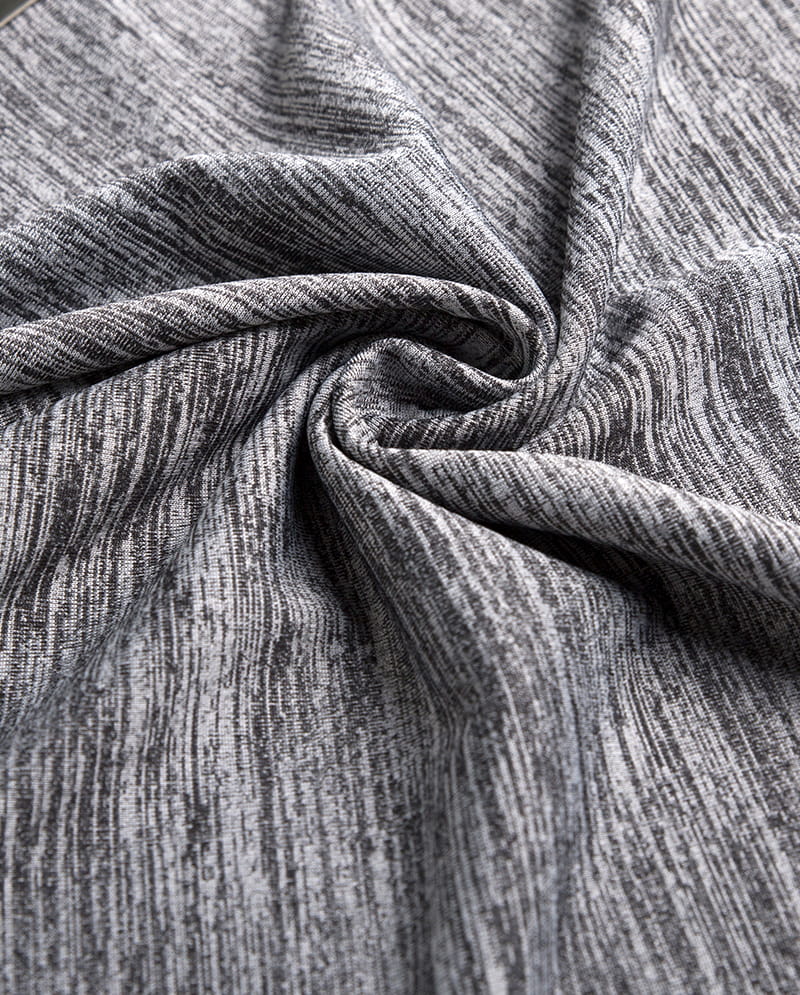
Anti-static Cationic Knitted Rib Fabric
-
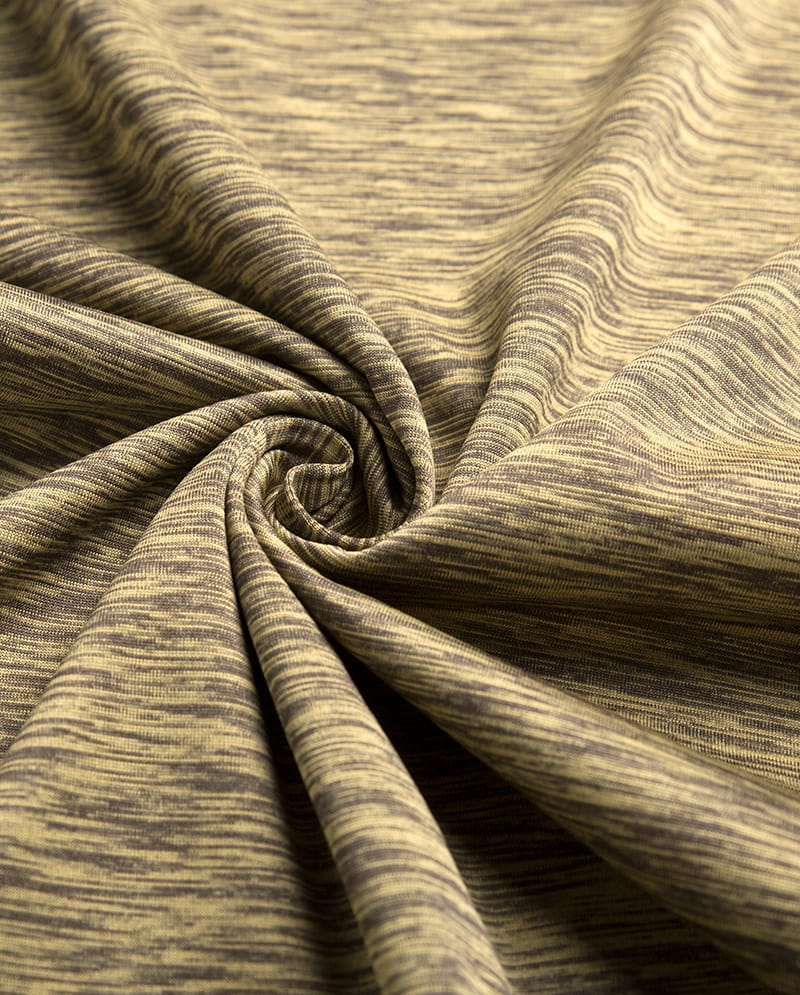
High-Stretch Cationic Jersey Fabric
-
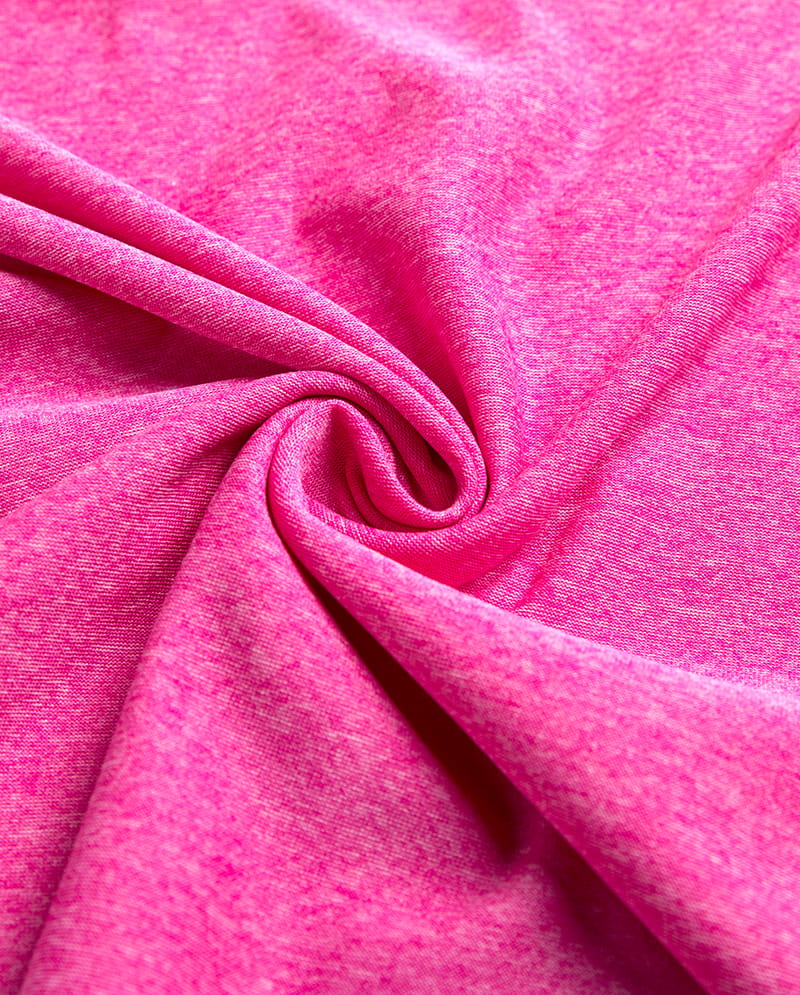
High Quality Cationic DTY Spandex Two Sides Brush Dralon Knit Fabric for Garment Thermal Underwear
-
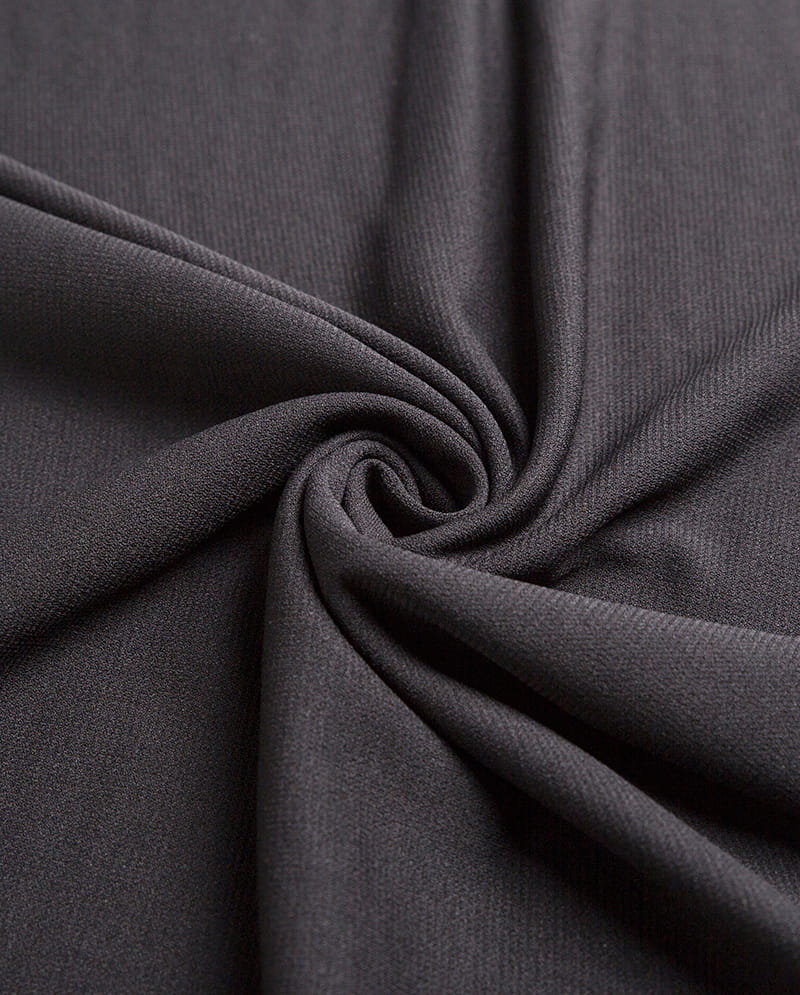
Durable Anti-Pilling Knitted Fabric for Home Textiles
-
Wash-Resistant Cationic Elastic Knitted Fabric for Garment Industry
-
Breathable Double-Faced Elastic Composite Fabric
-
-
-
- whatsapp:
- 0086-13962559622
-
- skype:
- skype.aliceshenghong
-
- Wechat:

COPYRIGHT © 2016 Suzhou Junhui Textile Co., Ltd.
