

 EN
EN English
 中文简体
中文简体Breathable Lightweight Tricot Mesh Fabric for High-Performance Applications
Content
- 1 1. Product Overview: What Makes Tricot Mesh Fabric Different
- 2 2. Key Advantages Over Conventional Mesh Fabrics
- 3 3. Technical Characteristics and Application Benefits
- 4 4. Manufacturing Strength: From Yarn Knowledge to Fabric Reliability
- 5 5. Process Flow: How Quality Is Built Into the Fabric
- 6 6. Product Performance Summary
- 7 7. Application Fields
- 8 8. Customization Possibilities
- 9 9. Why the Manufacturer’s Yarn Portfolio Matters
- 10 10. Competitive Advantages for Global Buyers
- 11 11. Design Considerations for Buyers
- 12 12. Quality Control and Testing Priorities
- 13 13. Sustainability and Responsible Material Development
- 14 14. Practical Purchasing Guidance
- 15 15. Frequently Asked Questions
- 15.1 Q1: What is breathable lightweight tricot mesh fabric mainly used for?
- 15.2 Q2: How is tricot mesh different from ordinary mesh fabric?
- 15.3 Q3: Can the fabric be customized?
- 15.4 Q4: Is this fabric suitable for recycled material programs?
- 15.5 Q5: Does lightweight mean the fabric is weak?
- 15.6 Q6: Can it be dyed in custom colors?
- 15.7 Q7: Can the fabric be coated or laminated?
- 15.8 Q8: Why choose a supplier with yarn development capability?
- 15.9 Q9: What information should buyers provide before requesting a quotation?
- 15.10 Q10: Is the fabric suitable for high-volume production?
- 16 16. Conclusion
- 17 References
- 18 Product: Breathable Lightweight Tricot Mesh Fabric
Breathable lightweight tricot mesh fabric is designed for manufacturers that need a stable, comfortable, and cost-effective material for products where air circulation, weight reduction, and durability must work together. Used in sportswear linings, industrial protective gear inner layers, automotive interior trim components, footwear accessories, bags, upholstery support layers, and functional textile composites, this fabric offers a practical balance between ventilation and structural reliability.
Unlike ordinary mesh fabrics that may stretch unevenly, deform after repeated washing, or feel rough against the skin, a well-engineered tricot mesh fabric is made with a fine warp-knitted structure that creates uniform micro-porous openings. These openings allow air to move quickly through the fabric, helping heat and moisture escape from the contact surface. At the same time, the warp-knitted construction improves dimensional stability, tear resistance, and long-term usability.
The product is especially valuable for buyers who need a fabric that can be customized through dyeing, coating, lamination, finishing, and functional treatments. It can be adapted to different colors, hand feels, weights, and performance requirements, making it suitable for both mass-market and specialized end uses.
Suzhou Junhui Textile Co., Ltd. and Suzhou Xiaoran New Material Co., Ltd. support this fabric with a strong foundation in yarn development, recycled yarn, polyester differential yarn, DTY yarn, FDY yarn, POY yarn, polyester chips, cationic dyeing yarn, flame-retardant yarn, microfine yarn, and knitted fabric products. Their experience in functional yarn and fabric development gives customers a flexible supply platform, from raw material selection to finished textile solutions.
Breathable Lightweight Tricot Mesh Fabric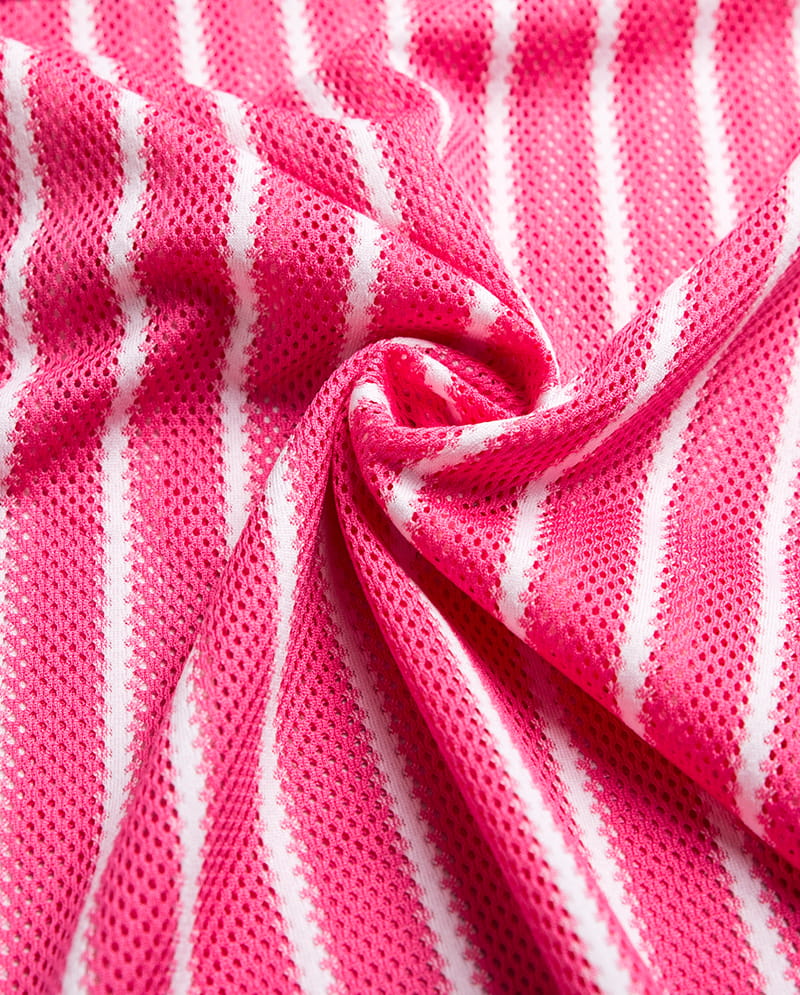
1. Product Overview: What Makes Tricot Mesh Fabric Different
Tricot mesh fabric belongs to the family of warp-knitted fabrics. In tricot knitting, yarns are guided in a controlled zigzag pattern, forming a stable structure with fine, consistent loops. This construction is different from many weft-knitted meshes, which can offer high elasticity but may also be more prone to curling, distortion, or laddering when damaged. Tricot mesh is valued because it combines breathability with a more controlled surface and a dependable shape.
The lightweight version of tricot mesh fabric is especially useful when designers want to reduce the total weight of a garment, protective layer, or interior component without sacrificing basic durability. In sportswear, a lighter lining can reduce fatigue and improve comfort. In protective gear, a breathable inner layer can help reduce heat buildup during long working hours. In automotive interiors, low-weight textile components can support efficiency goals while maintaining surface stability.
The product’s micro-porous structure is one of its key advantages. The pores are not random holes; they are formed by the knitting process, which allows the mesh to maintain a repeated and predictable geometry. This helps the fabric deliver consistent ventilation across the surface. In practical use, consistent air flow means better moisture evaporation, faster drying, and improved comfort for the end user.
Another important feature is adaptability. The fabric can be dyed to meet color requirements, coated for additional functionality, or combined with other materials through lamination. Depending on the end application, manufacturers may request softer hand feel, stronger tensile performance, anti-bacterial finishing, moisture-wicking treatment, flame-retardant performance, or recycled content. The fabric platform is broad enough to support many of these developments.
2. Key Advantages Over Conventional Mesh Fabrics
Many buyers compare tricot mesh with ordinary polyester mesh, nylon mesh, spacer fabric, woven netting, or low-cost lining fabrics. Each material has its own advantages, but lightweight tricot mesh stands out when the goal is to combine breathability, soft contact, stability, process compatibility, and economical production.
2.1 More Stable Than Many Weft-Knitted Meshes
Weft-knitted mesh can be elastic and comfortable, but it may deform more easily under repeated pulling or washing. Tricot mesh, because of its warp-knitted structure, usually offers better dimensional stability. This is important for products that must keep their original shape, such as sportswear lining panels, helmet padding supports, industrial gear layers, and automotive trim laminates.
2.2 More Comfortable Than Coarse Netting
Coarse woven netting or heavy mesh can feel harsh when used close to the body. Breathable lightweight tricot mesh can be engineered with a finer surface, making it more suitable for lining and contact-layer uses. When used inside apparel or equipment, it can reduce friction and improve wear comfort.
2.3 Lighter Than Many Spacer Fabrics
Spacer fabrics provide cushioning and airflow, but they are often thicker and heavier. In applications where cushioning is not the main function, lightweight tricot mesh can achieve ventilation with less bulk. This gives product designers more freedom when working with slim sportswear, compact protective gear, or interior trim components where thickness must be controlled.
2.4 Better Processing Flexibility Than Some Specialty Fabrics
Some specialty breathable fabrics are difficult to dye, coat, cut, sew, or laminate. Tricot mesh fabric is compatible with common textile processes, making it easier for manufacturers to integrate into existing production lines. It can be used as a lining, backing, reinforcement layer, decorative mesh, or functional intermediate material.
2.5 Strong Balance Between Performance and Cost
For many industrial buyers, the best material is not always the most expensive or the most technically complex. The best choice is often the one that delivers stable performance at a controllable cost. Lightweight tricot mesh fabric is attractive because it provides visible breathability, reliable handling, and customization potential while remaining suitable for volume production.
3. Technical Characteristics and Application Benefits
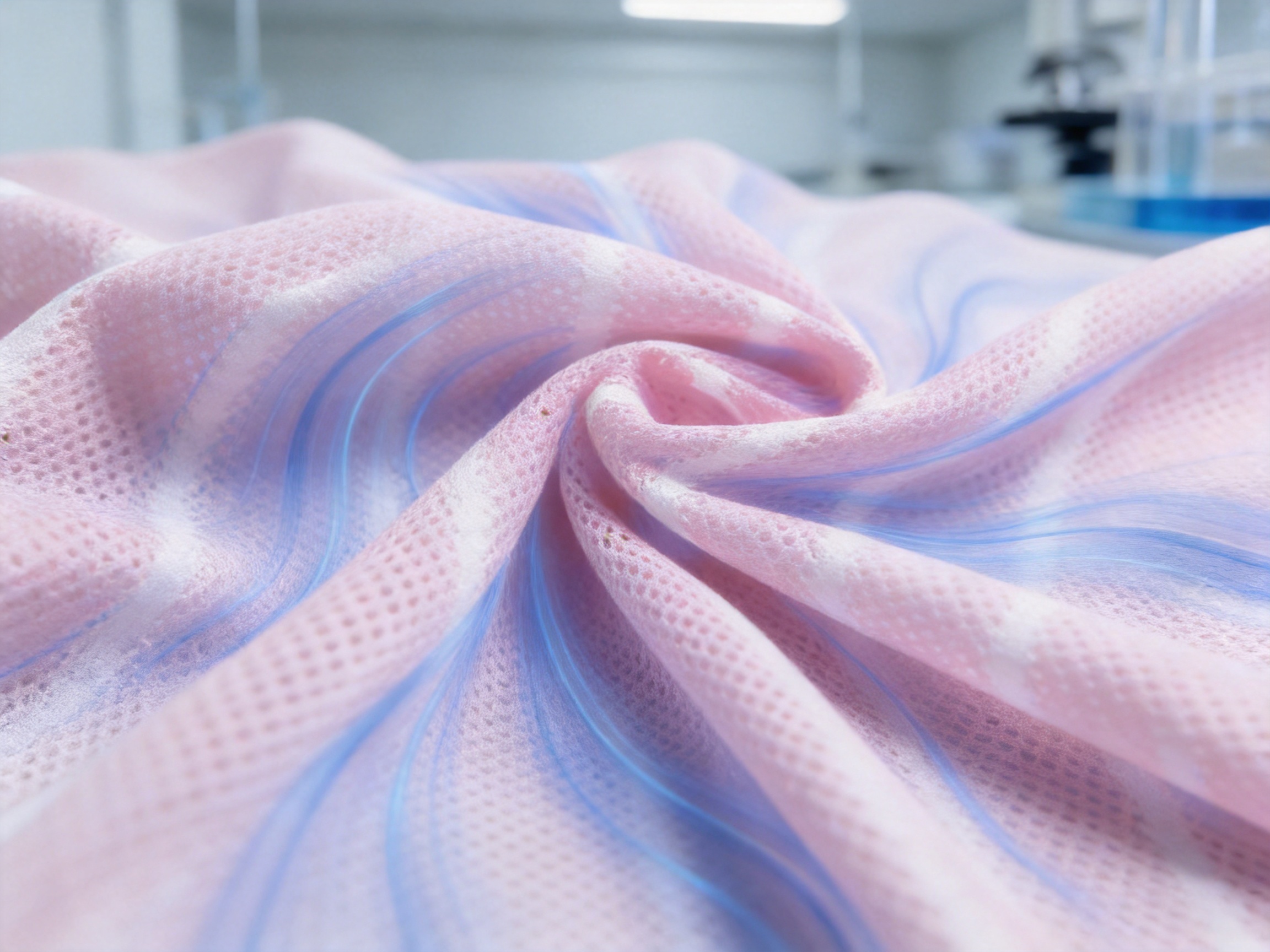
The performance of breathable lightweight tricot mesh fabric can be understood through several important characteristics: air permeability, weight, structural stability, moisture management, surface comfort, finishing compatibility, and durability during use.
3.1 Air Permeability
The fabric’s mesh openings allow air to pass through quickly. In sportswear, this helps reduce the feeling of trapped heat. In workwear and protective gear, ventilation can help improve comfort during physical activity. In automotive interiors, breathable textile layers can contribute to a more comfortable tactile and thermal experience.
3.2 Lightweight Performance
A lightweight textile reduces the total mass of the finished product. This is valuable in activewear, outdoor products, travel accessories, and vehicle interiors. Weight reduction can also improve shipping efficiency and material handling during manufacturing.
3.3 Structural Stability
The tricot structure resists tearing and deformation better than many loose mesh fabrics. This stability is particularly useful during cutting, sewing, bonding, coating, and lamination. A fabric that stays stable during processing helps reduce waste, improve production speed, and support consistent final product quality.
3.4 Moisture and Heat Dissipation
Moisture management is not only about absorbing water; it is also about helping vapor and heat leave the body or contact surface. The micro-porous design supports rapid air exchange, which can help sweat evaporate more efficiently when the fabric is used near the skin or as an inner lining.
3.5 Dyeing and Coating Compatibility
The fabric can be dyed in a wide range of colors and can accept basic coating or finishing processes. This is important for brands that need consistent color matching, functional layers, or specific appearance effects. Coatings may be selected depending on requirements such as stiffness, hand feel, abrasion performance, water resistance, or adhesion in composite structures.
3.6 Durability for Repeated Use
Products such as sportswear, safety equipment, bags, and automotive interior parts must withstand repeated use. The tricot structure helps the fabric maintain its integrity through handling, movement, washing, and long-term wear. While exact performance depends on the yarn specification and finishing process, the fabric’s construction provides a dependable base for durable textile products.
4. Manufacturing Strength: From Yarn Knowledge to Fabric Reliability
A major advantage behind this breathable lightweight tricot mesh fabric is the manufacturer’s deep connection with yarn development and textile material engineering. Suzhou Junhui Textile Co., Ltd. and Suzhou Xiaoran New Material Co., Ltd. have experience in differential yarn, recycled yarn, polyester drop-dyed yarn, microfine yarn, flame-retardant yarn, cationic dyeing yarn, and knitting fabric products. This background allows the fabric to be developed not only as a surface material, but as a complete textile solution based on suitable yarn selection and end-use performance.
Manufacturing quality begins before knitting. The yarn must be selected according to denier, filament count, luster, dyeing behavior, elasticity, strength, and functional requirement. For example, DTY yarn can contribute bulk, texture, and comfort. FDY yarn can provide smoothness and strength. Recycled polyester yarn can support environmental goals. Cationic dyeable yarn can create special dyeing effects or two-tone appearances. Flame-retardant yarn can be considered when safety performance is required.
Because the company works with a wide product range, it can support customized development more effectively than suppliers who only sell standard fabric items. Buyers can discuss target fabric weight, mesh size, color, elasticity, softness, recycled content, and finishing requirements. This flexibility is especially important for international brands and manufacturers that need consistent materials for different product series.
The company’s professional research and development team also provides an advantage. Functional textiles require careful coordination between raw material, knitting structure, dyeing, finishing, and final testing. A supplier with R&D capability can help customers solve issues such as fabric deformation, color inconsistency, insufficient breathability, poor coating adhesion, excessive stiffness, or unsatisfactory hand feel.
5. Process Flow: How Quality Is Built Into the Fabric
The production of breathable lightweight tricot mesh fabric can be divided into several stages. Each stage affects the final performance, appearance, and reliability of the product.
5.1 Raw Material Selection
The process begins with selecting suitable polyester yarns or functional yarns. Depending on the customer’s needs, the yarn may be normal polyester, recycled polyester, cationic dyeable yarn, microfine yarn, moisture-wicking yarn, or flame-retardant yarn. The chosen yarn must match the desired fabric weight, strength, elasticity, color performance, and finishing compatibility.
5.2 Yarn Preparation
Before knitting, yarn packages must be inspected for consistency. Uneven yarn tension, mixed lots, poor winding, or defects can create visible problems in the finished fabric. Proper yarn preparation helps maintain stable knitting performance and reduces the risk of broken ends, streaks, or irregular mesh formation.
5.3 Warp Knitting
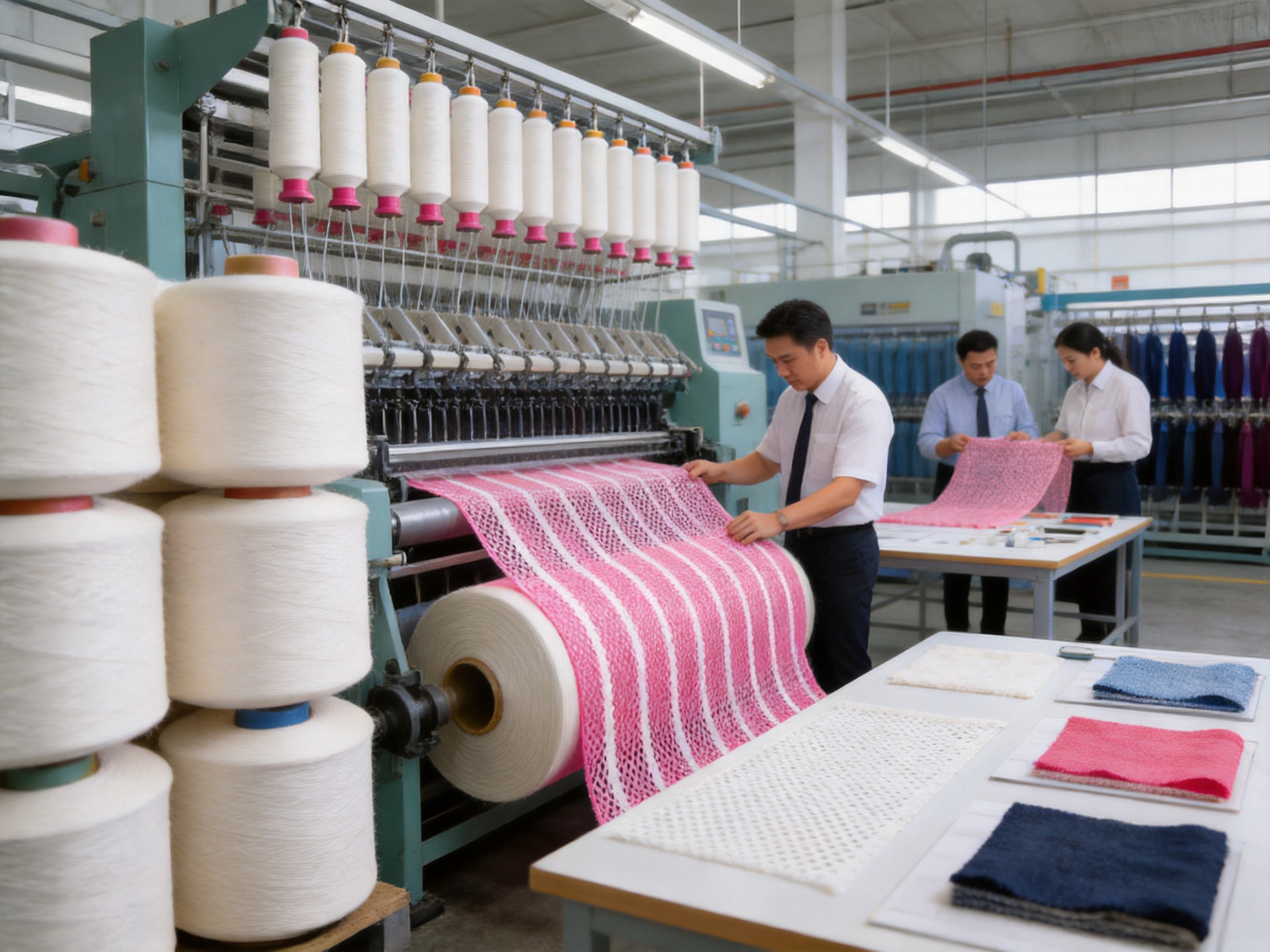
During tricot knitting, yarns are fed into the knitting machine under controlled tension. The guide bars move the yarns to form a stable loop structure. The machine settings determine mesh density, openness, thickness, and surface appearance. Skilled technical control is essential because small changes in tension, stitch length, or yarn path can affect breathability and fabric stability.
5.4 Greige Fabric Inspection
After knitting, the greige fabric is inspected for defects such as holes, broken yarns, needle lines, uneven mesh, stains, or width variation. Early inspection helps prevent defective material from moving into dyeing or finishing, reducing waste and improving delivery reliability.
5.5 Dyeing and Finishing
The fabric can be dyed according to customer color requirements. Finishing processes may include heat setting, softening, moisture-wicking finishing, anti-bacterial finishing, flame-retardant treatment, coating, or other functional modifications. Heat setting is particularly important for dimensional stability because it helps the fabric maintain width and shape.
5.6 Final Quality Control
Finished fabric is checked for width, weight, color, hand feel, appearance, strength, elongation, and other agreed parameters. For export customers, consistency between production batches is especially important. A reliable quality control system supports repeat orders and reduces problems during the customer’s cutting and sewing operations.
5.7 Packing and Delivery
Fabric is rolled, packed, labeled, and prepared for shipment. Good packing protects the mesh surface from contamination, crushing, moisture, and handling damage. Clear labeling helps customers manage inventory and production planning.
6. Product Performance Summary
Performance Area |
Fabric Advantage |
Customer Benefit |
Breathability |
Uniform micro-porous tricot mesh structure |
Improves air circulation and helps reduce heat buildup |
Weight |
Lightweight knitted construction |
Reduces burden in apparel, gear, and interior components |
Stability |
Warp-knitted structure resists deformation |
Supports easier cutting, sewing, lamination, and washing |
Comfort |
Fine surface with controlled mesh openings |
Suitable for lining and contact-layer applications |
Customization |
Compatible with dyeing, coating, and finishing |
Can be adapted to different colors, functions, and markets |
Material Options |
Can be developed with normal, recycled, or functional yarns |
Supports sustainability, safety, and performance requirements |
Cost Efficiency |
Suitable for stable volume production |
Helps manufacturers balance quality and purchasing cost |
7. Application Fields
7.1 Sportswear and Activewear Linings
In sportswear, comfort is strongly connected with breathability and weight. A lining that traps heat or absorbs too much moisture can reduce performance and create discomfort. Lightweight tricot mesh fabric is suitable for jackets, training apparel, shorts, running wear, cycling garments, team uniforms, and other activewear products. It can be used as a full lining, partial ventilation panel, pocket lining, reinforcement layer, or decorative mesh element.
The fabric’s smooth hand and controlled structure help it work well in garments that move with the body. It can help designers create apparel that feels lighter, dries faster, and maintains its shape after repeated use.
7.2 Industrial Protective Gear
Protective gear often requires multiple layers. The outer layer may provide resistance to abrasion, chemicals, flame, or mechanical impact, while the inner layer must maintain comfort. If the inner layer does not breathe, the wearer may experience heat stress, sweat accumulation, and reduced mobility. Breathable tricot mesh can serve as a comfort layer inside helmets, protective jackets, knee pads, gloves, workwear, and safety vests.
When combined with functional yarns or finishing processes, the fabric can be adapted for more demanding environments. For example, flame-retardant yarn or finishing can be considered for safety-related applications, while anti-bacterial finishing may be useful in products worn for long periods.
7.3 Automotive Interior Trim
Automotive interiors require materials that are durable, stable, attractive, and process-compatible. Lightweight tricot mesh can be used in seat backing, headliner support, door trim, ventilation layers, laminated composites, storage pockets, and interior decorative areas. Its low weight supports modern vehicle material strategies, while its stable structure helps in cutting, bonding, and assembly.
Automotive textile suppliers often need repeatable quality and controlled appearance. The tricot mesh structure provides a uniform surface that can be adapted with color, coating, or lamination according to design needs.
7.4 Footwear and Bags
Footwear and bags benefit from breathable materials that remain strong during daily use. Tricot mesh can be used in shoe linings, tongue materials, pocket layers, backpack panels, luggage interiors, and sports bag ventilation zones. The fabric provides airflow without unnecessary weight, and it can be combined with foam, nonwoven materials, or other textile layers.
7.5 Home and Outdoor Products
The fabric can also support outdoor equipment, camping products, home storage items, mattress ventilation layers, furniture components, and pet products. Wherever airflow, flexibility, and low weight are required, tricot mesh can provide an efficient textile solution.
8. Customization Possibilities
One of the strongest selling points of breathable lightweight tricot mesh fabric is its adaptability. Customers rarely need only a generic mesh. They often need a fabric that matches a specific product design, target price, durability requirement, color standard, or functional claim. The manufacturer’s yarn and fabric development background makes customized solutions more practical.
8.1 Yarn Specification Customization
The fabric can be developed with different yarn counts and filament combinations. Options may include DTY yarn for texture and comfort, FDY yarn for smoother performance, recycled yarn for environmental positioning, cationic dyeable yarn for special color effects, and functional yarn for performance needs. Denier and filament count influence softness, strength, opacity, weight, and mesh appearance.
8.2 Color Customization
Color is essential for apparel, accessories, and interior materials. The fabric can be dyed according to customer requirements, and color matching can be managed based on physical samples or standard color references. For products requiring high visual consistency, controlled dyeing and batch management are important.
8.3 Functional Finishing
Depending on the application, the fabric may be finished for moisture wicking, anti-bacterial performance, flame retardancy, softness, stiffness, water resistance, or improved bonding. Functional finishing must be selected carefully because every treatment can affect hand feel, breathability, color, and washing durability.
8.4 Width, Weight, and Mesh Structure
Different products require different fabric weights and widths. A sportswear lining may need a softer and lighter mesh, while an industrial backing layer may need higher strength. Mesh openness can also be adjusted to balance ventilation, coverage, appearance, and stability.
8.5 Recycled and Environment-Oriented Options
Many brands now require recycled content or more responsible material sourcing. Because the company offers recycled yarn series, customers can discuss fabric development using recycled polyester yarn. This can help brands meet sustainability goals while maintaining the practical advantages of polyester mesh.
9. Why the Manufacturer’s Yarn Portfolio Matters
The product information includes a broad yarn list covering recycled series, normal series, CD series, high-elastic series, functional series, cotton-like yarn, hollow warm yarn, and air-covered yarn. This matters because fabric quality is directly linked to yarn quality. A fabric supplier with strong yarn knowledge can better control fabric performance and respond to customer development requests.
For example, recycled SD DTY and recycled SD FDY can be considered for customers seeking recycled polyester options. CD DTY and SD plus CD DTY can support special dyeing behaviors. High-elastic yarn can help create stretch or recovery effects. Fire-retardant yarn, anti-bacterial yarn, and moisture-wicking yarn can support functional fabric development. Hollow warm yarn can be used when warmth and lower weight are required. Air-covered yarn can support stretch combinations.
This wide material base gives customers more than a single mesh fabric. It gives them access to a development system. If a customer’s first fabric version is too stiff, the yarn can be adjusted. If breathability is too low, the mesh structure can be changed. If color effect is not strong enough, dyeable yarn selection can be reviewed. If the end product needs recycled claims, recycled yarn can be considered. This flexibility is a major competitive advantage.
10. Competitive Advantages for Global Buyers
10.1 Integrated Textile Understanding
Some suppliers only trade finished fabric. Others focus only on yarn. A supplier with experience in yarn, fabric, and functional textile development can provide more complete support. This helps customers reduce communication gaps and shorten development time.
10.2 Export-Oriented Service
The company’s products are exported to many countries, and it has customer relationships across international markets. Export experience is important because global buyers require reliable communication, packaging, documentation, quality consistency, and delivery planning. The ability to support customers in different regions improves purchasing confidence.
10.3 Professional R&D Support
Functional textile development often involves trial and adjustment. R&D capability allows the manufacturer to discuss technical problems with customers and help develop suitable solutions. This is especially important for buyers working on new product lines or performance-driven products.
10.4 Broad Product Range
The manufacturer offers textile fabric, DTY yarn, FDY yarn, POY yarn, polyester chips, colored yarns, recycled yarn, differential yarn, and knitted fabric products. This broad range allows customers to source multiple related materials through one supplier, improving coordination and reducing procurement complexity.
10.5 Responsive Technical Communication
Fast response is valuable in textile sourcing. Buyers often need quick answers about specifications, sample lead times, production feasibility, color matching, packaging, and shipping. A service-oriented supplier that can provide professional guidance helps customers avoid delays.
11. Design Considerations for Buyers
When selecting breathable lightweight tricot mesh fabric, buyers should define the intended use clearly. A fabric for sportswear lining may require softness and moisture comfort, while a fabric for automotive trim may require dimensional stability and bonding performance. A fabric for protective gear may require durability and functional finishing.
11.1 Define the Contact Environment
If the fabric will touch skin, softness and irritation control are important. If it will be hidden inside a composite, strength, thickness, and bonding may matter more. If it will be exposed, color and appearance become key considerations.
11.2 Confirm Breathability Requirements
More open mesh generally improves air flow, but it may reduce coverage or strength. A tighter mesh can offer better opacity and stability but may reduce ventilation. The correct balance depends on the end product.
11.3 Consider Washing and Care
Garments and reusable gear may be washed many times. Buyers should discuss washing conditions, shrinkage tolerance, color fastness, and finishing durability. Heat setting and appropriate finishing can help improve dimensional stability.
11.4 Match Fabric to Production Process
If the fabric will be cut by automatic equipment, laminated, coated, ultrasonic welded, or sewn into complex shapes, processing behavior must be considered. Stable tricot mesh is generally easier to handle than loose or unstable mesh, but specifications should still be tested.
11.5 Request Samples and Testing
Before mass production, samples should be tested in real conditions. Buyers should evaluate hand feel, weight, air flow, color, sewing performance, coating adhesion, shrinkage, and final product appearance.
12. Quality Control and Testing Priorities
Quality control is essential for breathable lightweight tricot mesh fabric because small defects may become visible or affect processing. The main testing priorities include fabric weight, width, color consistency, mesh uniformity, tensile strength, tear resistance, dimensional stability, color fastness, and appearance inspection.
For apparel uses, comfort, hand feel, breathability, and washing performance are important. For industrial or automotive uses, durability, bonding, heat stability, abrasion resistance, and consistency across batches may be more important. For functional versions, testing should confirm the claimed performance, such as moisture wicking, anti-bacterial behavior, or flame-retardant properties.
A strong supplier will not treat quality inspection as a final step only. Quality must be managed throughout the entire process, from yarn selection to knitting, dyeing, finishing, packing, and shipment. This integrated quality mindset reduces risk for the customer and supports long-term cooperation.
13. Sustainability and Responsible Material Development
Polyester remains widely used because it is durable, versatile, and suitable for many textile processes. At the same time, global markets increasingly ask for recycled materials and more responsible sourcing. The availability of recycled yarn series allows breathable tricot mesh fabric to be developed with recycled polyester options when required.
Recycled polyester can help reduce reliance on virgin resources and support brand sustainability programs. However, sustainable textile development is not only about recycled content. It also includes durable product design, efficient production, reduced waste, consistent quality, and materials that perform well over a long service life. A fabric that fails quickly or causes high production waste is not truly efficient.
Lightweight tricot mesh supports sustainability in another way: it can reduce material usage by delivering ventilation and stability with less mass. In apparel, this can reduce garment weight. In automotive interiors, lower material weight can support broader lightweight design strategies. In packaging and shipping, lighter materials may also improve logistical efficiency.
14. Practical Purchasing Guidance
To achieve the best result when sourcing breathable lightweight tricot mesh fabric, buyers should prepare a clear technical brief. The brief should include application, target weight, width, color, yarn preference, recycled content requirement, finishing requirement, hand feel, strength expectation, washing condition, packaging preference, and estimated order quantity.
If the buyer has an existing sample, it should be provided for comparison. If not, the supplier can recommend suitable specifications based on the end use. Communication should cover not only price, but also performance, consistency, development time, testing, and after-sales support. In many cases, choosing the lowest-cost mesh without considering technical fit can lead to higher downstream costs due to cutting waste, sewing problems, returns, or product failure.
A supplier with strong technical experience can help customers select a fabric that performs reliably in the final product. This is particularly important for export customers, brand manufacturers, and factories producing large volumes where small quality differences can create significant production impact.
15. Frequently Asked Questions
Q1: What is breathable lightweight tricot mesh fabric mainly used for?
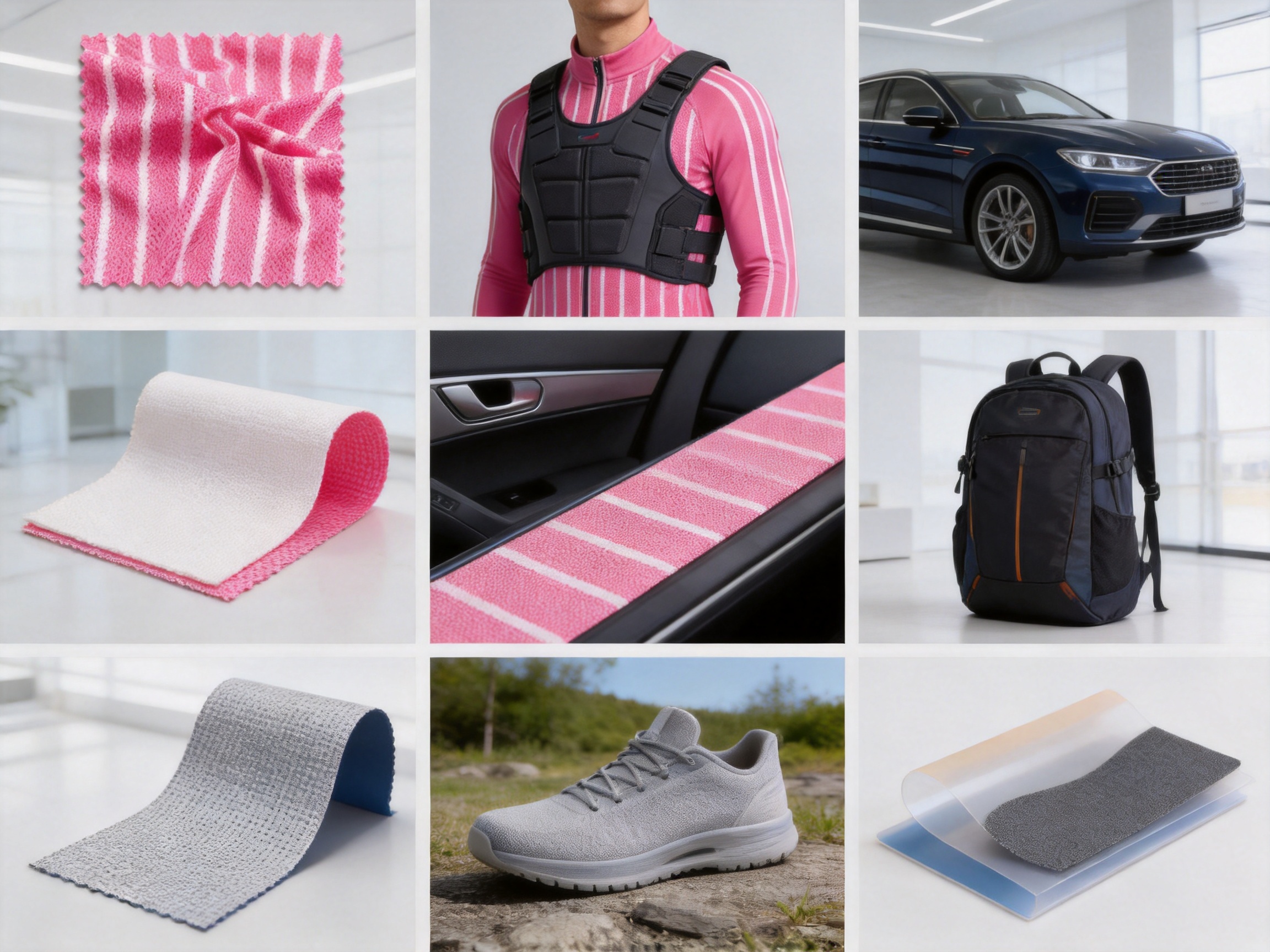
It is mainly used for sportswear linings, activewear ventilation panels, industrial protective gear inner layers, automotive interior trim components, footwear linings, bags, outdoor equipment, and functional textile composites. Its main value is the combination of air permeability, low weight, stability, and processing flexibility.
Q2: How is tricot mesh different from ordinary mesh fabric?
Tricot mesh is made with a warp-knitted structure, which generally provides better dimensional stability and a more uniform surface than many loose or weft-knitted mesh fabrics. This makes it easier to cut, sew, laminate, and use in products that require consistent performance.
Q3: Can the fabric be customized?
Yes. It can be customized in yarn selection, weight, width, color, mesh openness, hand feel, finishing, coating, and functional performance. Options may include recycled yarn, moisture-wicking finishing, anti-bacterial finishing, flame-retardant treatment, or cationic dyeing effects depending on requirements.
Q4: Is this fabric suitable for recycled material programs?
Yes. The manufacturer offers recycled yarn series, so the fabric can be discussed with recycled polyester options. Buyers should specify their recycled content targets and any certification or testing requirements before development.
Q5: Does lightweight mean the fabric is weak?
Not necessarily. Lightweight tricot mesh is designed to reduce mass while maintaining useful structural stability. The final strength depends on yarn specification, knitting density, finishing, and intended use. Samples should be tested for the actual application.
Q6: Can it be dyed in custom colors?
Yes. The fabric is compatible with dyeing processes, and custom colors can be developed based on customer requirements. Color fastness and batch consistency should be confirmed according to the end product’s quality standards.
Q7: Can the fabric be coated or laminated?
Yes. It can be used with coating or lamination processes, depending on the required function and final product construction. Testing is recommended to confirm adhesion, hand feel, breathability, and durability after processing.
Q8: Why choose a supplier with yarn development capability?
Yarn strongly influences fabric performance. A supplier with yarn development capability can adjust material selection, denier, filament count, dyeing behavior, elasticity, and functional properties. This helps customers obtain a fabric that better matches their exact application.
Q9: What information should buyers provide before requesting a quotation?
Buyers should provide application, target weight, width, color, quantity, function requirements, sample reference if available, testing standards, packaging needs, and delivery schedule. Clear information helps the supplier recommend the most suitable specification.
Q10: Is the fabric suitable for high-volume production?
Yes. Tricot mesh fabric is suitable for stable volume production when specifications are confirmed. The manufacturer’s experience in yarn and fabric supply supports repeat orders, export requirements, and customized production planning.
16. Conclusion
Breathable lightweight tricot mesh fabric is a practical and versatile material for manufacturers seeking air permeability, low weight, comfort, and structural reliability. Its fine warp-knitted construction creates uniform micro-porous gaps that help dissipate heat and moisture while maintaining stable handling during cutting, sewing, dyeing, coating, and lamination.
Compared with many conventional mesh materials, it offers a better balance of comfort, durability, customization, and cost efficiency. It is lighter than many bulky ventilation materials, more stable than many loose knits, and more comfortable than coarse netting. These advantages make it a strong choice for sportswear, protective gear, automotive interiors, footwear, bags, outdoor products, and other functional textile applications.
The manufacturer’s strength in differential yarn, recycled yarn, DTY yarn, FDY yarn, POY yarn, polyester chips, colored yarns, and knitted fabrics provides a strong foundation for customized development. With professional R&D support, export experience, and a broad material portfolio, customers can develop fabric solutions that match their performance, design, sustainability, and cost targets.
For brands and factories that need a dependable breathable mesh fabric, this product offers more than a simple textile layer. It provides a flexible platform for comfort, function, and manufacturing efficiency.
References
1. Spencer, D. J. Knitting Technology: A Comprehensive Handbook and Practical Guide. Woodhead Publishing.
2. Horrocks, A. R., and Anand, S. C. Handbook of Technical Textiles. Woodhead Publishing.
3. Saville, B. P. Physical Testing of Textiles. Woodhead Publishing.
4. Lawrence, C. A. Advances in Yarn Spinning Technology. Woodhead Publishing.
5. Kadolph, S. J. Textiles. Pearson Education.
6. Hu, J. Fabric Testing. Woodhead Publishing.
Product: Breathable Lightweight Tricot Mesh Fabric

Popular products
-
Premium Cationic Interlock Stretch Comfort Fabric
-
Moisture-Wicking Nylon Woven Fabric
-
Double-faced jacquard elastic fabric
-
Heather Grey Double-faced cationic jersey fabric
-
Anti-static Cationic Knitted Rib Fabric
-
High-Stretch Cationic Jersey Fabric
-
High Quality Cationic DTY Spandex Two Sides Brush Dralon Knit Fabric for Garment Thermal Underwear
-
Durable Anti-Pilling Knitted Fabric for Home Textiles
-
Wash-Resistant Cationic Elastic Knitted Fabric for Garment Industry
-
Breathable Double-Faced Elastic Composite Fabric
-
-
-
- whatsapp:
- 0086-13962559622
-
- skype:
- skype.aliceshenghong
-
- Wechat:

COPYRIGHT © 2016 Suzhou Junhui Textile Co., Ltd.
