

 EN
 English
 中文简体
Black DDB DTY (D/F) Recycled Functional Yarn: Sustainable Performance for Modern Textile Manufacturing
Content
- 1 1. Product Overview
- 2 2. Main Product Advantages
- 3 3. Manufacturing Process and Quality Advantages
- 4 4. Competitive Advantages Compared with Conventional Alternatives
- 5 5. Available Specifications and Product Portfolio
- 6 6. Recommended Applications
- 7 7. Sustainability and Resource Efficiency
- 8 8. Quality, Processing, and Testing Considerations
- 9 9. Why Choose the Supplier
- 10 10. Buying Guide for International Customers
- 11 11. Product Positioning for Brands and Manufacturers
- 12 12. Future Development Potential
- 13 13. Frequently Asked Questions
- 13.1 Q1: What is Black DDB DTY Recycled Functional Yarn?
- 13.2 Q2: What does DDB mean?
- 13.3 Q3: What does DTY mean?
- 13.4 Q4: Is the yarn made from recycled plastic bottles?
- 13.5 Q5: Does dope dyeing save water?
- 13.6 Q6: Is the black color resistant to fading?
- 13.7 Q7: Can the yarn be used for sportswear?
- 13.8 Q8: Can the supplier provide antibacterial or flame-retardant versions?
- 13.9 Q9: What specifications are available?
- 13.10 Q10: Can the yarn be customized?
- 13.11 Q11: What products can be made from this yarn?
- 13.12 Q12: How should customers begin a project?
- 14 14. Conclusion
- 15 References
- 16 Product: Black DDB DTY(D/F) Recycled Functional Yarn
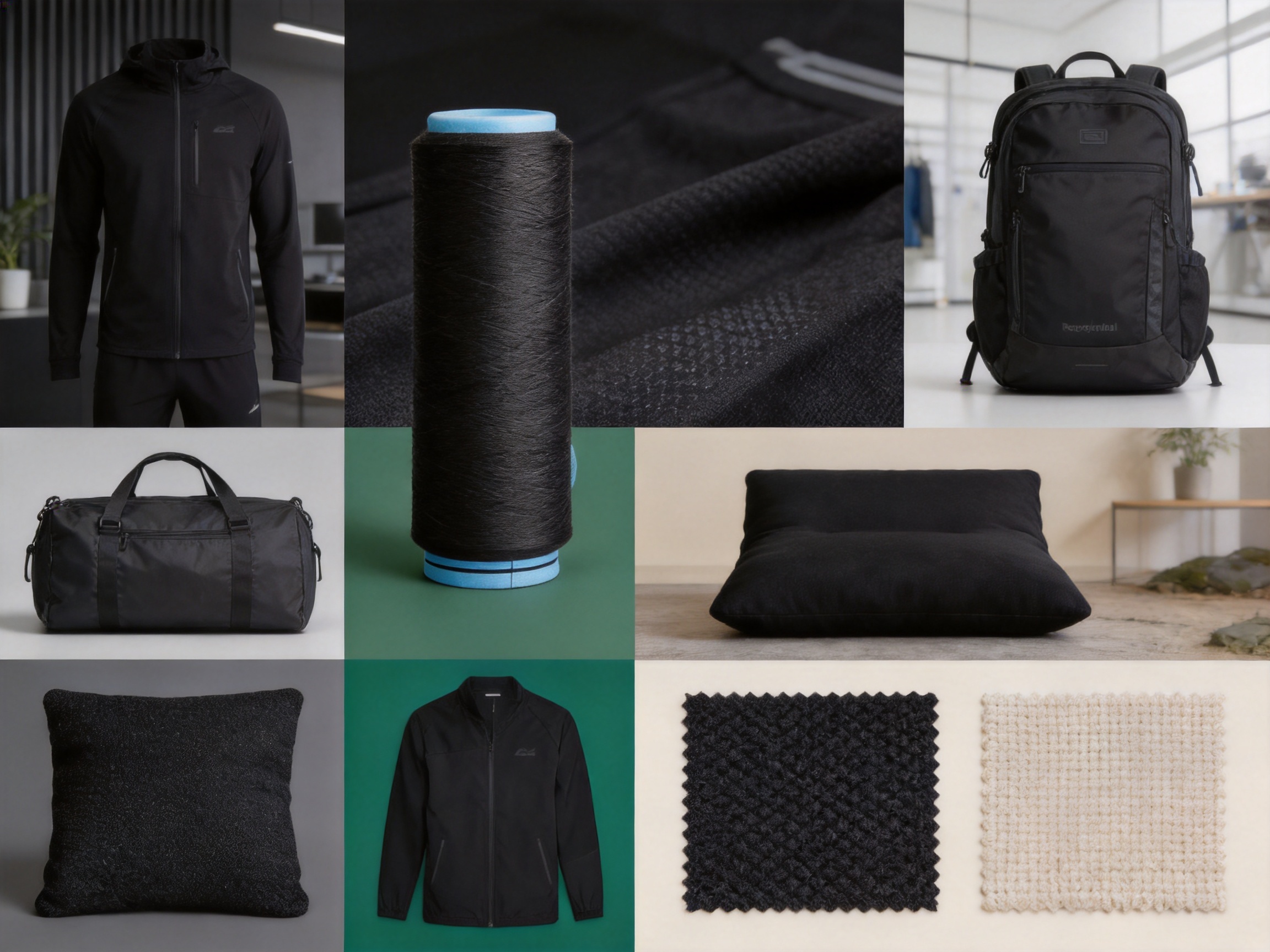
Textile manufacturers are under increasing pressure to reduce environmental impact while continuing to deliver reliable quality, attractive appearance, efficient processing, and competitive pricing. This demand has accelerated the development of recycled polyester yarns that can replace conventional virgin-polymer materials in a wide range of applications. Black DDB DTY (D/F) Recycled Functional Yarn is designed to answer this need by combining recycled content, dope-dyed color, textured softness, processability, and optional functional performance in one versatile textile solution.
Made from recycled PET resources, including post-consumer plastic bottles, this yarn supports a more circular approach to polyester production. The material transforms discarded plastic into a usable textile input, helping reduce dependence on virgin petroleum-based raw materials. At the same time, its black dope-dyed construction provides stable coloration and can reduce the resource consumption commonly associated with after-dyeing.
The product is manufactured and supplied by Suzhou Junhui Textile Co., Ltd., together with Suzhou Xiaoran New Materials Co., Ltd. The companies specialize in differential yarns, recycled yarns, dope-dyed polyester yarns, functional yarns, and knitting fabric products. Their experience in product development, export service, and customized yarn production allows buyers to select yarn structures and functions according to the requirements of a specific fabric, garment, or technical textile project.
Unlike a basic recycled polyester yarn that offers only an environmental benefit, this product is positioned as a performance-oriented material. Its DTY structure provides a soft and flexible hand feel, while DDB coloration creates a deep black appearance with strong resistance to ordinary fading. The yarn can also be developed with functions such as moisture management, antibacterial performance, ultraviolet resistance, or flame retardancy, depending on the intended specification.
1. Product Overview
Black DDB DTY (D/F) Recycled Functional Yarn is a recycled polyester yarn produced for applications requiring a combination of sustainability, color stability, softness, and dependable textile processing. The yarn belongs to the recycled yarn category and is suitable for weaving, knitting, and selected non-woven applications.
The term “recycled” refers to the use of recovered PET-based resources as a feedstock. PET bottles and other suitable polyester waste can be processed, purified, and converted into polymer material for spinning. Using this approach gives post-consumer waste a second life as a textile resource rather than allowing it to remain in landfills or enter natural environments.
“DDB” refers to dope-dyed black coloration. Instead of applying color only after the yarn has been formed, pigment or colorant is introduced into the polymer melt before extrusion and spinning. This creates color throughout the polymer structure. The result is a yarn with a consistent black appearance and improved color stability during normal use.
“DTY” means draw textured yarn. Through drawing and texturing, the yarn develops bulk, flexibility, softness, and a degree of natural stretch or recovery. These qualities make DTY suitable for fabrics that require comfort and surface fullness rather than the smooth, rigid appearance associated with some flat filament yarns.
The product can be supplied in different denier and filament combinations. Typical options listed for recycled DDB DTY include 75/36–72, 150/48, and 300/96. The exact choice depends on fabric construction, target weight, cover factor, hand feel, knitting or weaving equipment, and end-use requirements.
2. Main Product Advantages
2.1 Recycled Material Content
One of the most important advantages of the yarn is its use of recycled PET resources. The supplied product information identifies the yarn as containing approximately 98% post-consumer recycled materials such as PET plastic bottles. This high recycled content makes the yarn attractive to brands and manufacturers developing products with recycled-material targets or circularity objectives.
Recycled polyester does not eliminate every environmental impact associated with textile production, but it can reduce reliance on virgin polyester feedstock. It also creates a market for recovered plastic materials. When properly collected and processed, discarded bottles can become a consistent raw material for new yarn rather than a single-use product with no further value.
For buyers, recycled content can support sustainability communication, responsible sourcing programs, and product certification strategies. Depending on the project, customers may also require documentation regarding recycled content, production batches, chain of custody, or third-party certification. These requirements should be confirmed during order preparation because documentation availability can vary by specification and production batch.
2.2 Dope-Dyed Black Color
Black coloration is integrated during polymer processing rather than being applied only after spinning. This dope-dyeing approach has several practical benefits. Because the color is incorporated into the polymer, the yarn can demonstrate strong resistance to fading caused by washing, abrasion, and sunlight under normal conditions.
Dope dyeing may also reduce the need for a separate post-spinning dyeing stage. Traditional dyeing often involves water, heating, auxiliaries, washing, drying, and wastewater treatment. By introducing color during extrusion, the manufacturing route can be streamlined for suitable products. This may help reduce water consumption, energy demand, processing time, and the amount of wastewater generated during coloration.
For textile mills, a dope-dyed yarn can simplify production planning. The yarn arrives with its target black color, reducing dependence on dye-house scheduling and minimizing risks related to shade variation during later dyeing. It is especially useful for products that require a stable black appearance across repeated production runs.
Black dope-dyed yarn can also offer strong visual depth. The color is suitable for apparel, bags, luggage, uniforms, home textiles, outdoor products, and accessories where a durable dark appearance is important. As with every colored yarn, customers should confirm shade standards, lightfastness requirements, and batch tolerance before bulk production.
2.3 Soft and Flexible DTY Structure
The DTY construction gives the yarn a textured profile rather than a completely flat filament structure. This creates a softer and more voluminous touch. The yarn can contribute to fabric comfort, surface fullness, and a more natural textile appearance.
DTY is widely used in knitted and woven fabrics because it can provide flexibility and a pleasant hand feel. It is suitable for fabrics that need movement and comfort, including sportswear, casual apparel, linings, fashion fabrics, bags, and home textile products. The appropriate texturing level can be selected according to the desired stretch, bulk, recovery, and surface effect.
The product description also identifies D/F characteristics. In practical procurement, buyers should confirm the exact meaning of the D/F designation, including the yarn construction, drawing condition, filament arrangement, and applicable test standards. The supplier can recommend a suitable specification based on the machine type and intended fabric construction.
2.4 Functional Development Options
The yarn is part of a broader functional-yarn development program. Depending on customer requirements, possible functions include moisture wicking, antibacterial performance, ultraviolet resistance, flame retardancy, hollow-warm properties, high elasticity, cationic dyeing, cotton-like effects, and PBT/PET elastic constructions.
Not every function is included automatically in every black DDB DTY specification. Functional performance must be defined and tested according to the agreed product standard. However, the supplier’s product range demonstrates the ability to develop yarns for different performance targets rather than offering only standard recycled filament.
Moisture-wicking versions may be considered for sportswear, activewear, underwear, socks, and other garments where faster moisture transfer is required. Antibacterial yarns may be developed for selected apparel, household textiles, and hygiene-related applications. Flame-retardant yarns may be considered for applications where reduced flammability is important, subject to the relevant safety standards.
Functional development is most successful when the yarn is designed together with the final fabric. Fiber cross-section, filament count, denier, texturing, finish, knitting structure, and finishing process all influence performance. For this reason, technical discussion before production is valuable for reducing trial-and-error during sampling.
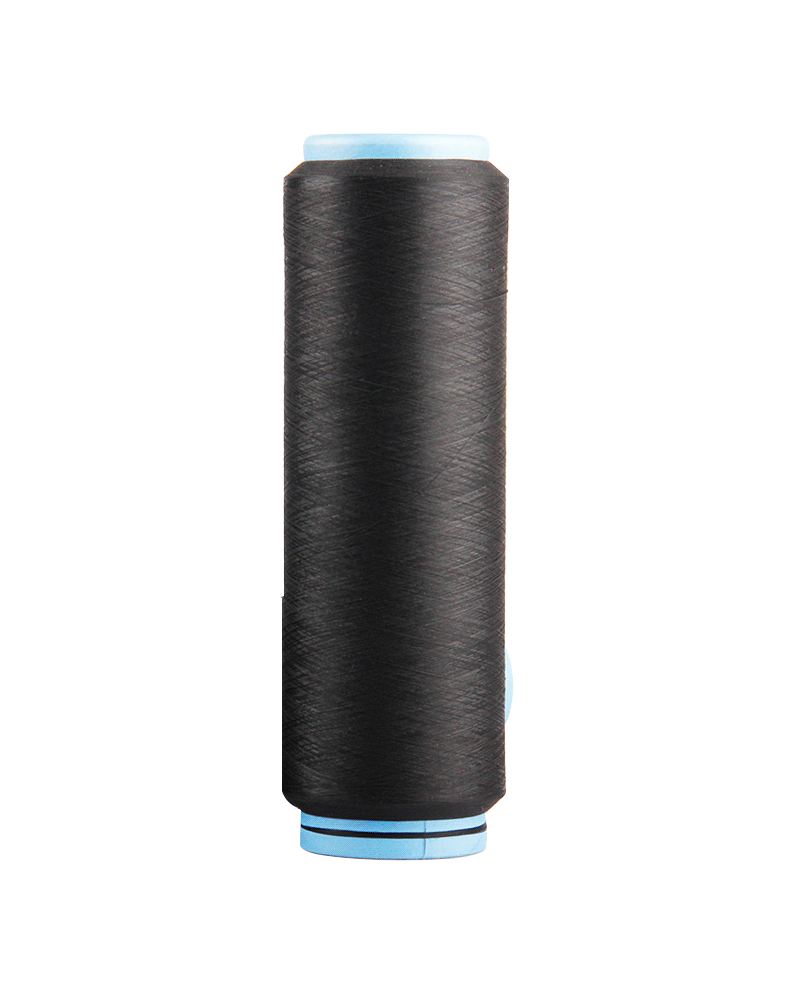
Black DDB DTY(D/F) Recycled Functional Yarn
3. Manufacturing Process and Quality Advantages
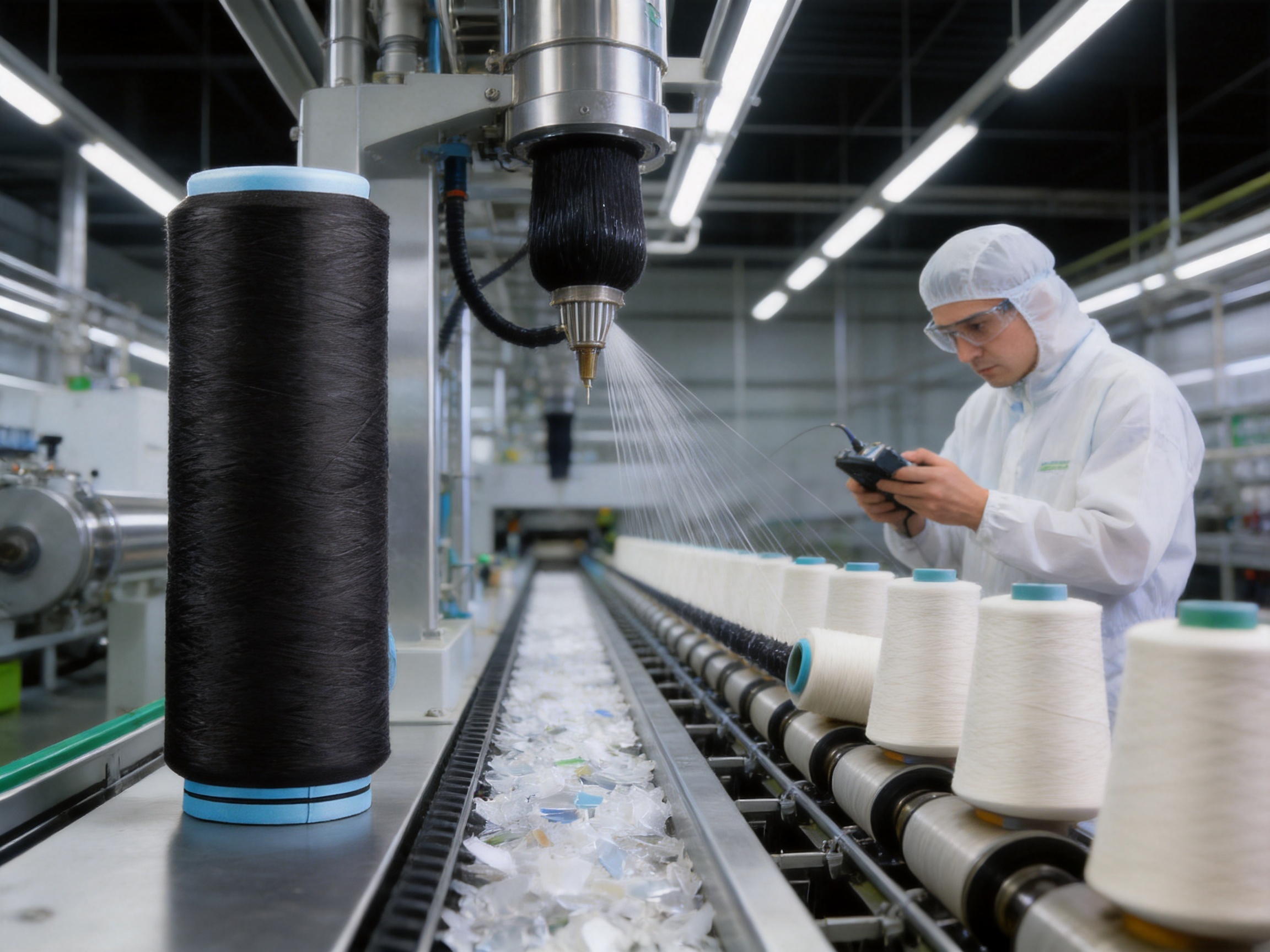
The quality of recycled functional yarn depends on more than the source material. It is influenced by feedstock selection, recycling treatment, polymer preparation, spinning stability, dope-dye dispersion, drawing, texturing, winding, packaging, and inspection. A controlled process is essential because recycled polymer can contain more variability than virgin polymer if it is not carefully sorted and purified.
3.1 Feedstock Selection and Preparation
The production process begins with the selection of suitable PET-based recycled resources. Post-consumer bottles and other polyester materials are collected, sorted, and prepared for processing. Materials with unsuitable polymers, excessive contamination, or incompatible additives must be removed as far as possible.
Sorting and cleaning are important because contamination can affect polymer color, viscosity, spinning stability, and yarn strength. The recovered material is therefore processed through steps such as crushing, washing, separation, drying, and purification before it is converted into a usable polyester feedstock.
For recycled black yarn, the dope-dyed color can also help create a stable visual result by establishing the target color during polymer preparation. Nevertheless, the underlying feedstock still requires consistent quality control. Variation in recycled inputs can influence the final product if the preparation system is not adequately controlled.
3.2 Polymer Preparation
Prepared recycled PET material is converted into polymer suitable for melt spinning. Moisture control is particularly important because polyester is sensitive to hydrolysis during high-temperature processing. Excess moisture can reduce molecular weight and negatively affect spinning stability or yarn strength.
Controlled drying and temperature management help maintain a more stable polymer condition. The material is then melted and filtered before extrusion. Filtration removes remaining solid impurities and helps protect the spinneret and downstream equipment. Stable melt quality supports more consistent filament formation.
For dope-dyed yarn, black colorant is dispersed into the polymer melt. Uniform dispersion is essential to achieving consistent color, avoiding pigment agglomeration, and maintaining smooth spinning. The formulation must balance color depth with processability, mechanical properties, and the required appearance of the finished yarn.
3.3 Melt Spinning
During melt spinning, the polymer is extruded through a spinneret to form continuous filaments. The spinneret design, extrusion temperature, cooling conditions, and take-up speed influence the diameter and uniformity of the filaments.
A stable spinning process helps control linear density, filament consistency, yarn strength, elongation, and appearance. For recycled yarn, maintaining stable spinning conditions is especially important because changes in polymer viscosity can create unevenness or breakage if the process is not adjusted correctly.
The supplier’s product range includes different denier and filament-count combinations. These options allow textile manufacturers to select a yarn suitable for fine, medium, or heavier fabric structures. A higher filament count may support a softer and more covered surface, while denier selection influences fabric weight and durability.
3.4 Drawing and Texturing
After spinning, the filaments undergo drawing and texturing to produce DTY characteristics. Drawing aligns the polymer molecules and develops the desired strength and elongation. Texturing introduces bulk and crimp, helping the yarn achieve a softer touch and more flexible behavior.
Texturing parameters influence the final fabric. Overly low texturing may result in insufficient bulk, while excessive texturing can affect processability, uniformity, or fabric appearance. The correct balance depends on the intended application and the customer’s equipment.
Consistent tension control is important throughout drawing and texturing. Uneven tension can lead to differences in crimp, dye appearance, fabric coverage, or package performance. Careful control of temperature, speed, feed ratio, and winding conditions supports a more uniform product.
3.5 Winding and Package Formation
After texturing, the yarn is wound onto packages suitable for transport and further processing. Package density, winding tension, package shape, and yarn release behavior can affect performance on knitting and weaving machines.
A well-formed package should unwind smoothly without excessive tension variation, snarling, or breaks. This is particularly important for high-speed textile machinery. Stable winding can improve production efficiency and help reduce material loss at the customer’s facility.
The supplier can discuss package requirements with customers according to machine type and regional logistics. Buyers should specify cone size, net weight, winding direction, inner tube dimensions, packaging materials, labeling, and pallet requirements when requesting a quotation.
3.6 Inspection and Technical Support
Quality inspection may include checks for denier, filament count, tenacity, elongation, crimp, oil content, evenness, color, package appearance, and unwinding behavior. The exact test items should be agreed according to the product specification and end use.
Technical support is another important strength. Suzhou Junhui Textile Co., Ltd. and Suzhou Xiaoran New Materials Co., Ltd. maintain a professional research and development team focused on differential yarns, environmental protection, functional materials, and textile applications. This capability helps customers move from a general concept to a practical yarn specification.
The companies report that more than 90% of their products are exported and that they have developed customer relationships in 36 countries. International experience can be valuable when customers require export documentation, communication across time zones, customized packing, or support with product selection.
4. Competitive Advantages Compared with Conventional Alternatives
4.1 Compared with Virgin Polyester DTY
Virgin polyester DTY is widely used because of its stable processing performance and broad availability. However, it is produced from newly extracted petroleum-based resources. Black DDB DTY Recycled Functional Yarn offers a more resource-conscious alternative by incorporating recovered PET material.
For brands with recycled-content goals, the recycled yarn can provide a direct material solution without requiring a complete change in fabric construction. The same general categories of knitting, weaving, and finishing equipment may be used, although technical trials are always recommended before bulk production.
The recycled yarn also offers dope-dyed coloration and functional development options. This combination can help distinguish it from standard virgin DTY products that may require conventional dyeing and additional finishing treatments.
4.2 Compared with Conventionally Dyed Polyester Yarn
Conventionally dyed yarn is colored after spinning. This method can provide a wide range of shades, but it may involve multiple wet-processing stages. Water, energy, dye auxiliaries, washing, drying, and wastewater treatment can all contribute to the environmental burden of production.
Black DDB yarn receives its color during polymer processing. For black products, this can reduce the need for later dyeing and support more efficient production. Dope dyeing can also provide strong colorfastness because the colorant is incorporated within the polymer rather than remaining only on the filament surface.
Another advantage is color consistency. When the dope-dye formulation and polymer process are controlled, the yarn can deliver a repeatable black shade across production batches. This is useful for large orders involving multiple fabric lots or supply locations.
4.3 Compared with Basic Recycled Yarn
Some recycled yarns focus mainly on recycled content. Black DDB DTY Recycled Functional Yarn adds further value through dope-dyed color, texturing, and optional functional engineering. These characteristics allow the yarn to compete not only on sustainability but also on performance and design requirements.
A fabric manufacturer may select a basic recycled yarn for a standard article, but a functional recycled yarn can be more appropriate when the final product requires comfort, moisture management, antibacterial properties, high elasticity, flame resistance, or outdoor durability.
The product range also includes recycled SD DTY, recycled SD FDY, recycled FD DTY, recycled SD+CD DTY, recycled CD DTY, and recycled DDB DTY. This broader portfolio gives customers more opportunities to coordinate yarns across different fabric constructions and product lines.
4.4 Compared with Solution-Dyed Black Fibers from Other Sources
Some solution-dyed black fibers are designed for highly specialized industrial applications and may not offer the flexibility required for fashion, bags, home textiles, or general apparel. The yarn range described here includes multiple denier and filament configurations, supporting a broader selection of textile structures.
The supplier can also develop differential yarns rather than limiting production to one standard specification. This is useful for buyers who need a specific hand feel, surface effect, stretch level, or functional combination. Customization can be particularly important for brands seeking a distinctive fabric identity.
5. Available Specifications and Product Portfolio
The supplied product list includes several recycled yarn categories. The following table summarizes representative specifications. These figures are product-list references rather than a complete technical data sheet. Final denier, filament count, color standard, performance level, package weight, and certification status should be confirmed before ordering.
| Product family | Representative specifications | Typical development direction |
|---|---|---|
| Recycle SD DTY (D/F) | 15/6; 20/12–24; 30/12–24–36; 50/36–48–72; 75/36–72–144; 100/36–48–96–144; 150/48–96–144–288; 300/96–192–288–576 | Soft, semi-dull recycled textured yarns for general textile use |
| Recycle SD FDY (D/F) | 40/24–72; 50/24–36–48–72; 66/24; 75/36–72–144; 100/72; 150/48–144 | Smoother recycled filament constructions and fabric surface effects |
| Recycle FD DTY (D/F) | 50/72; 75/36; 75/72; 150/144 | Bright or fully drawn textured options for selected fabric designs |
| Recycle DDB DTY (D/F) | 75/36–72; 150/48; 300/96 | Dope-dyed black recycled yarn with stable coloration |
| Recycle CD DTY (D/F) | 75/36–72 | Cationic-dyeable recycled yarn development |
| Recycle SD+CD DTY (D/F) | 50/48–72; 75/48–72; 80/72; 100/72–108–144; 125/72–144; 150/72–108–144; 300/96–144–288 | Combined effects for contrast, texture, or specialized coloration |
| Functional recycled yarns | Moisture wicking, antibacterial, flame retardant, high elastic, hollow warm, cotton-like, and other differentiated options | Application-specific performance development |
The range demonstrates that the supplier can support both standard and customized requirements. Buyers should not select a specification solely by denier. The final decision should consider filament count, yarn brightness, texturing level, strength, elongation, fabric density, machine gauge, finishing route, and the desired visual effect.
For example, a 75-denier yarn with different filament counts can create noticeably different fabric surfaces. A finer filament arrangement may produce a softer touch, while another construction may improve cover or durability. Similarly, a 150-denier yarn can be used in lightweight outerwear, bags, linings, and home textiles depending on the filament configuration and fabric structure.
6. Recommended Applications
6.1 Apparel
The yarn is suitable for fashion apparel, casual garments, sportswear, uniforms, jackets, trousers, skirts, and selected knitted products. Its black color is appropriate for garments where a stable dark appearance is required. DTY texture can contribute to comfort and softness, while recycled content supports sustainability-oriented collections.
For activewear, a moisture-wicking version may be considered. However, moisture management is determined by the complete fabric system, including yarn cross-section, knitting pattern, fabric weight, finishing, and garment design. The yarn should therefore be tested in the final fabric rather than evaluated in isolation.
For uniforms and workwear, durability, abrasion resistance, colorfastness, and care performance may be key priorities. A suitable denier and functional finish can be selected according to the expected use, washing frequency, and required service life.
6.2 Bags and Luggage
Recycled PET yarn is especially relevant to bags, backpacks, shopping bags, handbags, luggage, briefcases, gift bags, and storage products. These products often benefit from a strong, durable, and visually stable textile surface.
Black DDB yarn can help create a consistent dark appearance for bag fabric, lining, webbing-related textiles, and decorative components. Its recycled origin can also support product stories centered on plastic recovery and responsible material selection.
For heavier bags and luggage, buyers may select higher denier constructions or combine the yarn with suitable woven structures, coatings, reinforcements, and sewing specifications. Abrasion and tear tests should be conducted on the finished material because the final performance depends on construction rather than yarn alone.
6.3 Home Textiles
Potential home textile applications include curtains, cushion covers, upholstery-related fabrics, blankets, bed products, decorative fabrics, and household storage goods. The soft DTY structure can improve hand feel, while black dope-dyed coloration may be advantageous for products exposed to repeated handling or washing.
For home textiles, manufacturers should consider dimensional stability, pilling, colorfastness to laundering, light exposure, abrasion, and applicable flammability regulations. Functional options can be evaluated for specific applications, but performance claims should be based on documented test results.
6.4 Outdoor Products
Outdoor products such as mountaineering bags, travel bags, backpacks, camping accessories, and outdoor clothing can benefit from recycled polyester yarn. The material offers a practical way to introduce recycled content into products that already rely on polyester-based fabrics.
Black dope-dyed yarn is useful where resistance to visible fading is important. Outdoor products may also require ultraviolet resistance, water repellency, coating compatibility, abrasion resistance, and color stability. These properties should be developed as part of the complete fabric specification.
6.5 Non-Woven and Decorative Uses
Depending on the yarn construction, Black DDB DTY Recycled Functional Yarn may also support selected non-woven, decorative, and interior applications. Its color and recycled origin can be attractive for display materials, organizers, soft accessories, and interior textile components.
Non-woven processing requirements differ from knitting and weaving. Buyers should confirm whether the yarn is suitable for the intended bonding, needle-punching, thermal, or composite process. The supplier can advise on yarn structure and function based on the planned manufacturing route.
7. Sustainability and Resource Efficiency
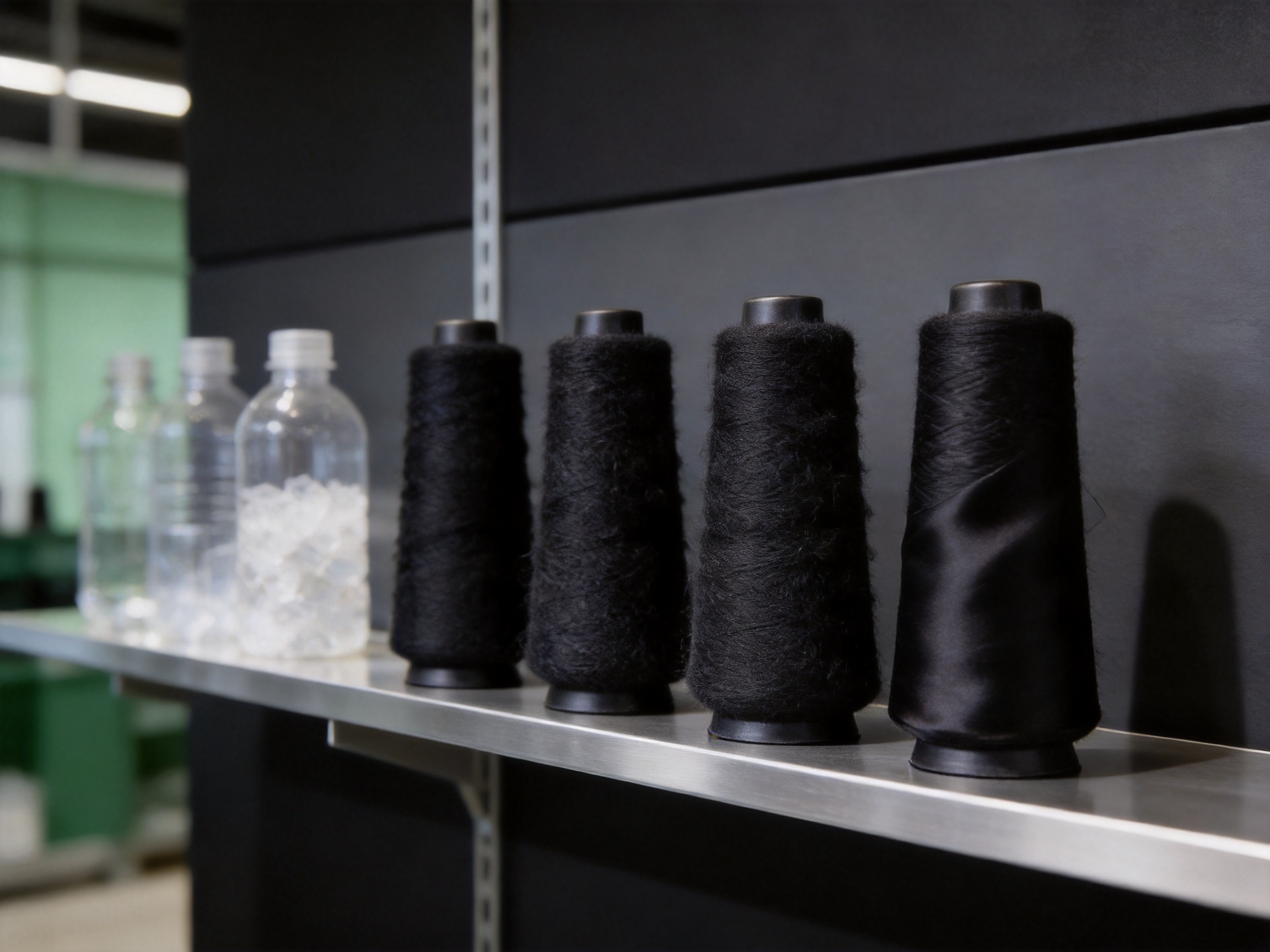
The sustainability value of the yarn comes from several connected factors rather than one isolated feature. First, recycled PET material is used as an alternative to wholly virgin polyester feedstock. Second, dope-dyed coloration can reduce the need for conventional wet dyeing. Third, the yarn can be engineered for long-lasting textile products, helping manufacturers create materials with useful service lives.
Using recycled resources supports the recovery of plastic waste. PET bottles are commonly collected and processed into flakes, chips, or other intermediate materials before being converted into filament yarn. This creates a connection between post-consumer waste management and textile manufacturing.
Dope dyeing may reduce water demand because the final yarn does not necessarily require a separate dye bath for black coloration. It can also reduce the use of dyeing auxiliaries and lower the volume of wastewater requiring treatment. The actual environmental benefit depends on the complete manufacturing system, energy source, processing conditions, and comparison baseline.
For responsible communication, brands should avoid treating recycled content as a guarantee of zero environmental impact. Product sustainability should be assessed through verified information, suitable documentation, and a realistic understanding of the full life cycle. Recycled yarn is nevertheless an important tool for reducing dependence on virgin resources and improving material circularity.
Customers may request documentation such as recycled-content declarations, production records, test reports, or certification documents. The exact documents depend on the market, customer policy, and product claim. Early communication is recommended when the yarn will be used for a certified or regulated program.
8. Quality, Processing, and Testing Considerations
8.1 Yarn Testing
Before bulk production, buyers should evaluate the yarn according to the requirements of the intended fabric. Common checks include linear density, filament count, tenacity, elongation, evenness, crimp, shrinkage, oil content, color, and package appearance.
Color testing should include black shade consistency and colorfastness appropriate to the application. Possible tests include washing, rubbing, perspiration, light exposure, and heat-related resistance. The most relevant test method depends on the destination market and final product category.
8.2 Fabric Trials
Yarn performance cannot be fully assessed without fabric trials. Knitting or weaving conditions can influence appearance, stretch, recovery, pilling, hand feel, and dimensional stability. A yarn that performs well in one fabric construction may require different settings in another.
Trial production should examine machine speed, tension, breakage, needle or loom behavior, fabric uniformity, and finishing response. For black dope-dyed yarn, the trial should also confirm whether the color meets the customer’s standard after finishing and repeated care cycles.
8.3 Functional Verification
If the product is ordered with moisture-wicking, antibacterial, flame-retardant, ultraviolet-resistant, or other functional properties, the exact performance target must be defined before production. Testing should be conducted using recognized methods and, where appropriate, on the finished fabric or garment.
Functional performance can change during dyeing, heat setting, coating, calendaring, washing, or other finishing operations. A product specification should therefore identify whether the claimed performance applies to the yarn, fabric, or finished article. This distinction helps avoid misunderstandings between suppliers, mills, brands, and end users.
8.4 Packaging and Storage
Polyester yarn should be stored in a clean, dry environment away from direct sunlight, excessive heat, and moisture. Packages should remain protected until processing. Improper storage can affect unwinding, package condition, and processing stability.
Export packaging should be designed to protect the yarn during handling and transportation. Carton labels can include product name, specification, lot number, net weight, gross weight, quantity, production date, and customer reference. Consistent labeling supports traceability and inventory management.
9. Why Choose the Supplier
Suzhou Junhui Textile Co., Ltd. and Suzhou Xiaoran New Materials Co., Ltd. were founded in June 2015 and focus on differentiated yarn development and sales. Their product scope includes recycled yarn, polyester dope-dyed yarn, SHAWLIENCE, microfine yarn, flame-retardant yarn, cationic-dyeing yarn, functional yarn, and knitting fabric products.
The companies emphasize research, development, and application. Their professional R&D team works with internationally recognized enterprises on environmental-protection and functional-yarn projects. This background supports a more consultative approach to product selection, especially when the customer’s requirements do not match a standard catalog item.
Another strength is experience with international business. With more than 90% of products exported and customers in 36 countries, the supplier understands the importance of communication, documentation, delivery coordination, and consistency for overseas buyers.
The product portfolio covers recycled, normal, cationic, high-elastic, functional, cotton-like, hollow-warm, and other differentiated series. This breadth allows customers to compare multiple yarn routes through one supplier. It may also simplify sourcing for brands that need several yarn types across different collections.
The company states that its service team aims to respond to customers within 12 hours globally. Fast communication can be useful when buyers are managing sampling deadlines, technical questions, production changes, or urgent quotation requests. Customers can contact the company through email, telephone, or WhatsApp for product selection and order discussions.
10. Buying Guide for International Customers
When requesting a quotation for Black DDB DTY (D/F) Recycled Functional Yarn, customers should provide as much technical information as possible. The request should identify the required denier, filament count, texturing type, brightness, black shade, recycled-content target, functional requirements, package size, order quantity, and delivery destination.
The end use should also be explained. A yarn for sportswear may require different properties from a yarn for luggage, upholstery, or decorative fabric. Information about the knitting gauge, loom type, fabric construction, fabric weight, finishing process, and performance testing can help the supplier recommend a more appropriate specification.
Sample development is recommended before placing a large order. Samples allow the customer to evaluate hand feel, color, processability, fabric appearance, dimensional stability, and functional performance. If the buyer uses a specific fabric standard, a reference sample can help the supplier understand the desired result.
Customers should also confirm production lead time, minimum order quantity, payment terms, packing, shipping method, loading plan, inspection arrangements, and document requirements. For recycled products, documentation should be discussed at the beginning rather than after production has started.
A clear approval process is helpful. The buyer may approve the yarn sample, color standard, package appearance, technical data sheet, and pre-production sample before bulk manufacturing. This reduces the possibility of disagreement and establishes a common quality reference.
11. Product Positioning for Brands and Manufacturers
Brands can position this yarn as part of a more responsible material strategy. The recycled PET origin offers a clear narrative that consumers can understand: used plastic resources are recovered and transformed into new textile material. The black dope-dyed process adds a second point of differentiation by connecting color production with potential reductions in conventional dyeing requirements.
Manufacturers can position the yarn as a practical balance between sustainability and production performance. Rather than choosing between an environmentally preferable material and a functional material, buyers can develop a yarn that addresses both objectives.
For fashion brands, the product can support black apparel collections, accessories, bags, and lifestyle products. For outdoor brands, it can contribute to backpacks, travel goods, and performance fabrics. For home textile companies, it can provide a recycled input for dark-colored decorative or functional products.
Marketing claims should remain accurate and supported by evidence. Terms such as “recycled,” “dope-dyed,” “colorfast,” “antibacterial,” “flame retardant,” or “moisture wicking” should be used according to the actual specification and available test documentation. A transparent claim strategy protects both the brand and the supplier.
12. Future Development Potential
The future of polyester yarn development is likely to involve greater use of recycled feedstocks, improved traceability, lower-impact coloration, and more specialized performance. Black DDB DTY Recycled Functional Yarn is aligned with these trends because it combines recycled material with an efficient coloration route and a platform for functional customization.
Further development may focus on improved recycled-polymer consistency, finer filament structures, enhanced stretch recovery, lower-temperature processing, and more durable functional effects. The combination of recycled content and textile engineering can help manufacturers create products that meet increasingly demanding environmental and technical standards.
There is also potential for wider integration with circular product design. Recycled yarn can be incorporated into products designed for longer service life, repair, reuse, or eventual recycling. Product designers may consider mono-material constructions, compatible trims, detachable components, and simplified finishing to improve end-of-life options.
Supplier collaboration will remain important. Textile mills and brands can share information about material goals, product performance, customer expectations, and manufacturing limitations. This allows the yarn to be developed for the complete value chain instead of being selected only by a short technical description.
13. Frequently Asked Questions
Q1: What is Black DDB DTY Recycled Functional Yarn?
It is a recycled polyester draw textured yarn with dope-dyed black coloration and the potential for additional functional properties. It is designed for textile applications requiring recycled content, a stable black appearance, softness, flexibility, and reliable processing.
Q2: What does DDB mean?
DDB refers to dope-dyed black. The black colorant is introduced into the polymer during melt processing before the filament is formed. This differs from conventional dyeing, in which color is generally applied after the yarn or fabric has been produced.
Q3: What does DTY mean?
DTY means draw textured yarn. Drawing develops the filament structure, while texturing creates bulk, crimp, softness, and flexibility. DTY is commonly used in knitted and woven fabrics for apparel, home textiles, bags, and other products.
Q4: Is the yarn made from recycled plastic bottles?
The supplied information states that the yarn is made from recycled PET resources, including discarded water bottles and other post-consumer materials. The product description identifies approximately 98% post-consumer recycled material. Buyers requiring formal certification or chain-of-custody documentation should confirm the available documents for the specific order.
Q5: Does dope dyeing save water?
Dope dyeing can reduce or eliminate the need for a separate conventional dyeing stage for the specified color. This may lower water use, energy consumption, dye auxiliaries, and wastewater generation compared with a traditional dyeing route. The actual reduction depends on the complete production process and the comparison method.
Q6: Is the black color resistant to fading?
Dope-dyed coloration is designed to provide strong colorfastness because the colorant is integrated into the polymer. Actual performance depends on the formulation, production control, fabric construction, finishing, and exposure conditions. Buyers should request and approve relevant colorfastness test results.
Q7: Can the yarn be used for sportswear?
Yes, it can be considered for sportswear and activewear. A moisture-wicking or other performance version may be developed when required. The final fabric must be tested because moisture management depends on yarn structure, fabric design, finishing, and garment construction.
Q8: Can the supplier provide antibacterial or flame-retardant versions?
The product portfolio includes antibacterial and flame-retardant yarn categories. These functions require a specific technical specification and appropriate testing. Customers should define the required standard, performance level, durability, and final application before ordering.
Q9: What specifications are available?
Representative recycled DDB DTY options include 75/36–72, 150/48, and 300/96. The broader recycled portfolio includes additional SD DTY, FDY, FD DTY, CD DTY, and SD+CD DTY specifications. Availability should be confirmed according to the required denier, filament count, brightness, package, and order quantity.
Q10: Can the yarn be customized?
The supplier states that it can accept orders for different kinds of differentiated yarn. Customization may involve denier, filament count, color, function, texturing, package form, or a combination of these factors. Technical feasibility and minimum order requirements should be discussed before sampling.
Q11: What products can be made from this yarn?
Potential applications include apparel, sportswear, uniforms, bags, backpacks, luggage, handbags, shopping bags, home textiles, outdoor products, decorative fabrics, and selected non-woven materials. The correct yarn specification depends on the final product and manufacturing process.
Q12: How should customers begin a project?
Customers should provide the intended application, yarn specification, recycled-content target, color requirements, function, order quantity, delivery destination, and testing expectations. The supplier can then recommend a suitable yarn, prepare samples, and discuss production and documentation requirements.
14. Conclusion
Black DDB DTY (D/F) Recycled Functional Yarn offers a balanced solution for textile manufacturers seeking sustainable materials without giving up practical performance. Its recycled PET origin supports resource recovery and reduces reliance on virgin polyester. Its dope-dyed black coloration can improve color stability while reducing the need for conventional wet dyeing. Its DTY structure contributes softness, bulk, and flexibility, and its functional-yarn platform allows additional performance properties to be developed for specific applications.
The product is supported by a broad range of recycled and differentiated yarn options, technical development experience, export capability, and customer-oriented service. Suzhou Junhui Textile Co., Ltd. and Suzhou Xiaoran New Materials Co., Ltd. can assist buyers with specification selection, sampling, functional development, and production coordination.
For brands, the yarn can support recycled-material collections and responsible product positioning. For textile mills, it provides a practical material option for knitting, weaving, and selected non-woven applications. For product developers, it creates opportunities to combine black color, recycled content, comfort, durability, and functional performance in one yarn platform.
As sustainability requirements continue to shape the textile industry, materials such as Black DDB DTY Recycled Functional Yarn can help connect environmental responsibility with dependable manufacturing. The best results will come from early technical cooperation, realistic performance targets, appropriate testing, and transparent documentation throughout the supply chain.
References
1. Product information and technical specification list supplied for Black DDB DTY (D/F) Recycled Functional Yarn.
2. Supplier information for Suzhou Junhui Textile Co., Ltd. and Suzhou Xiaoran New Materials Co., Ltd.
3. General principles of recycled PET fiber and polyester yarn manufacturing.
4. General textile engineering practices for melt spinning, drawing, texturing, winding, and yarn inspection.
5. General sustainability considerations for recycled materials and dope-dyed polyester products.
Product: Black DDB DTY(D/F) Recycled Functional Yarn

Popular products
-
Premium Cationic Interlock Stretch Comfort Fabric
-
Moisture-Wicking Nylon Woven Fabric
-
Double-faced jacquard elastic fabric
-
Heather Grey Double-faced cationic jersey fabric
-
Anti-static Cationic Knitted Rib Fabric
-
High-Stretch Cationic Jersey Fabric
-
High Quality Cationic DTY Spandex Two Sides Brush Dralon Knit Fabric for Garment Thermal Underwear
-
Durable Anti-Pilling Knitted Fabric for Home Textiles
-
Wash-Resistant Cationic Elastic Knitted Fabric for Garment Industry
-
Breathable Double-Faced Elastic Composite Fabric
-
-
-
- whatsapp:
- 0086-13962559622
-
- skype:
- skype.aliceshenghong
-
- Wechat:

COPYRIGHT © 2016 Suzhou Junhui Textile Co., Ltd.
